Address
Sector 14, Road no. 18, Uttara, 1230
Dhaka, Bangladesh

Rx Prescripttion Only-YMYL Medical Content
Approved, in combination with dexamethasone, for adults with relapsed or refractory multiple myeloma (RRMM) after at least four prior therapies and refractory to two proteasome inhibitors, two immunomodulatory agents, and an anti-CD38 antibody (“penta-refractory” or “triple-class refractory” disease) — and, in combination with bortezomib and dexamethasone, for myeloma after one or more prior therapies. Also approved for certain diffuse large B-cell lymphoma (DLBCL) patients.
1
2
3
4
MD
Medical Oncologist Review
Board-certified oncologist · 12+ years in thoracic malignancies
Content reviewed against FDA prescribing information, NCCN Guidelines v2.2024, and published Phase III trial data. Last updated June 2026.
These steps help you have an informed conversation. A confirmed EGFR mutation result is the starting point for any treatment decision.
Medical disclaimer: This page is for informational purposes only and does not constitute medical advice, diagnosis, or treatment. It is a prescription medication that must only be used under the supervision of a qualified oncologist. Clinical outcomes data is drawn from published Phase III trials; individual results vary. Always consult your healthcare provider and refer to the full prescribing information before making any treatment decisions. Emergency: call your local emergency services or poison control immediately if you experience serious adverse effects.
Here are key questions to bring to your hematologist about starting selinexor — given how heavily pretreated most patients are at this point, the conversation around realistic expectations and proactive side-effect management deserves as much weight as the practical dosing questions.
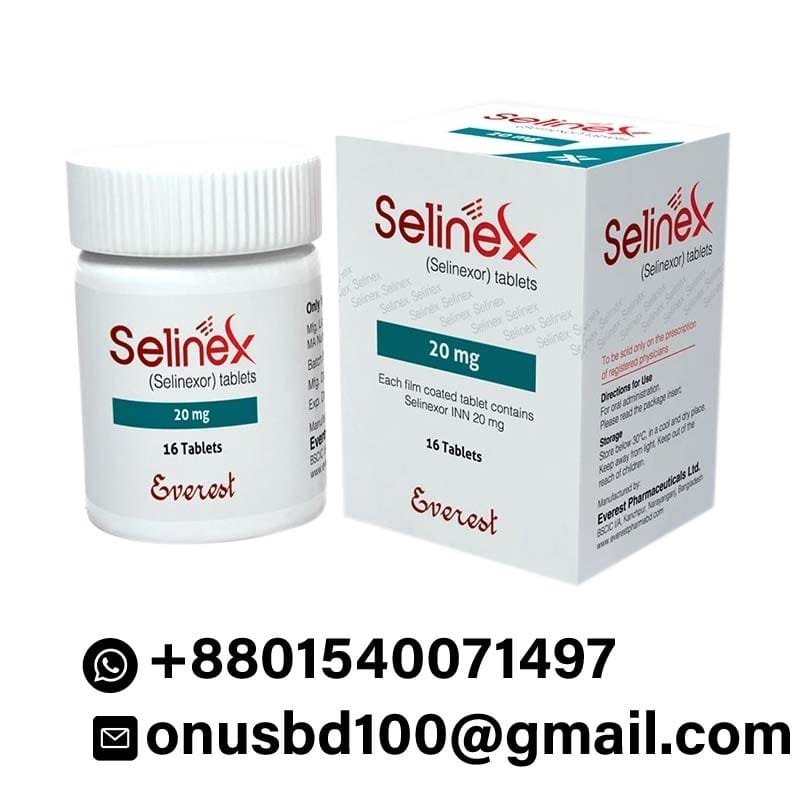
Before confirming Selinex(selinexor) as your treatment
About thrombocytopenia — the most dose-limiting side effect
About neutropenia and infection risk
About nausea and nutrition — starting proactively, not reactively
About hyponatremia
About cataracts
About the dosing schedule
About managing fatigue
About my specific situation
About monitoring response
About the longer road
A practical tip: Because nausea and dehydration management work best when started before symptoms appear rather than after, it’s worth asking specifically whether anti-nausea medication will be prescribed alongside your first dose of selinexor — not held in reserve for if symptoms develop. Many patients find the first cycle is the most challenging, and proactive management from day one makes a meaningful difference in tolerating treatment long enough to see whether it’s working.
What they fundamentally are
| Selinexor (Selinex) | CAR-T cell therapy | |
|---|---|---|
| Type | Oral small-molecule drug | One-time cellular therapy — your own T-cells, genetically engineered |
| Administration | Take-home pills, weekly dosing, ongoing | Single infusion after a multi-step manufacturing process |
| Approved products | One drug (selinexor) | Idecabtagene vicleucel (Abecma/ide-cel) and ciltacabtagene autoleucel (Carvykti/cilta-cel) — both target BCMA on myeloma cells |
| Where it’s given | Outpatient, ongoing visits | Requires apheresis, cell manufacturing (weeks), then specialized infusion center admission |
The efficacy gap is substantial
| Selinexor (STORM) | Ide-cel (KarMMa) | Cilta-cel (CARTITUDE-1) | |
|---|---|---|---|
| Overall response rate | 26% | 73% | 98%, with 83% achieving stringent complete response |
| Median PFS | 3.7 months | 8.8 months | 2-year PFS of 60.5% |
| Median OS | 8.6 months | 24.8 months | 2-year OS of 71% in patients achieving stringent CR |
This is a meaningful difference, not a marginal one. A CAR-T cell therapy is, in some clinicians’ direct comparison, dramatically more effective than older salvage options that achieve response rates of around 30% at best in this same heavily pretreated population — selinexor falls into that lower-efficacy category, while CAR-T represents a genuine step-change in outcomes for this same patient group.
Why selinexor still exists despite CAR-T’s superior efficacy
This gap doesn’t mean selinexor is obsolete — it exists for important practical reasons:
Eligibility — CAR-T requires adequate organ function, reasonable performance status, and the ability to tolerate potentially serious acute toxicities. Older or frailer patients, or those with significant comorbidities, may not be candidates.
Timing — CAR-T manufacturing and the apheresis-to-infusion process takes weeks, during which a patient’s rapidly progressing myeloma may need “bridging therapy” to control disease — selinexor or other options can serve this purpose.
Access — CAR-T is only administered at specialized, certified treatment centers, often requiring travel and an extended stay near the treatment center. Selinexor can be managed by any oncology practice with standard monitoring capability.
Manufacturing failure or relapse after CAR-T — patients whose CAR-T product fails to be manufactured successfully, or who relapse after CAR-T, still need other options — selinexor remains relevant in this scenario too.
Cost and insurance authorization timing — CAR-T is extremely expensive and the approval/scheduling process can take time that a clinically declining patient may not have.
Side effect profiles — completely different categories of risk
| Selinexor | CAR-T cell therapy | |
|---|---|---|
| Most distinctive risks | Thrombocytopenia, fatigue, nausea, hyponatremia | Cytokine release syndrome (CRS) and neurologic complications including immune effector-cell-associated neurotoxicity syndrome (ICANS) |
| Severity pattern | Chronic, manageable, ongoing | Acute, occurs in first 1-2 weeks after infusion, can be severe |
| Hospitalization | Generally outpatient | Required — specialized inpatient monitoring for CRS/ICANS |
| Long-term blood count effects | Present throughout treatment | Prolonged and recurrent cytopenias after the acute phase |
| Reversibility of decision | Can stop and switch relatively easily | One-time intervention — cannot be “undone” once cells are infused |
CRS and ICANS are serious enough that these toxicities require specific management by skilled health professionals — meaning CAR-T isn’t just more effective, it’s also a fundamentally higher-acuity, higher-monitoring-burden treatment in its first few weeks, even though it’s a single infusion rather than ongoing therapy.
Where this fits in the treatment sequence today
Randomized trials have confirmed CAR-T’s superiority over standard regimens even earlier in the relapsed setting — KarMMa-3 showed ide-cel significantly improved PFS compared with standard regimens, and CARTITUDE-4 demonstrated improved PFS with cilta-cel versus standard-of-care therapy in lenalidomide-refractory myeloma, meaning CAR-T is increasingly being considered earlier in the disease course rather than reserved only for the most heavily pretreated, penta-refractory patients where selinexor was originally positioned.
Bottom line
If you’re eligible for CAR-T therapy and a center can perform it within your clinical timeline, the efficacy data strongly favors it over selinexor for relapsed/refractory myeloma — the response rate and survival differences are substantial, not marginal. Selinexor remains clinically important specifically for patients who aren’t CAR-T candidates, need bridging therapy while CAR-T is being arranged, have relapsed after CAR-T, or face access barriers (geographic, insurance, or capacity-related) that make CAR-T impractical in their timeframe. This is a conversation where asking directly “am I a candidate for CAR-T, and if so, how quickly could that be arranged” is one of the most important questions you can bring to your hematologist — ideally one affiliated with or able to refer to a CAR-T-certified center, since this decision can meaningfully change the treatment trajectory.
XPO1 stands for Exportin 1, and understanding selinexor’s mechanism requires first understanding a basic cellular process most cancer drugs don’t touch at all: how proteins move between the nucleus and the rest of the cell.
The basic biology — nuclear transport
Every cell has a nucleus, where DNA lives and where many critical regulatory proteins need to do their work. But proteins are made outside the nucleus and need to be actively transported in and out through tiny pores in the nuclear membrane. This transport isn’t passive — it’s managed by specific “carrier” proteins, and exportin 1 (XPO1) is the primary carrier responsible for moving a large group of proteins out of the nucleus and into the rest of the cell.
This matters enormously for cancer because among the proteins XPO1 routinely exports are tumor suppressor proteins — proteins like p53, p21, and FOXO, whose entire job is to sit inside the nucleus and tell a cell to stop dividing, repair damage, or self-destruct (apoptosis) if something has gone wrong. If these tumor suppressors get pumped out of the nucleus and kept in the cytoplasm, they can’t do their job — the cell loses its internal “off switch.”
What cancer cells do with this
Many cancers, including multiple myeloma, exploit this system by overexpressing XPO1 — essentially running the export pump harder than normal. This keeps tumor suppressor proteins chronically exiled from the nucleus, effectively disabling the cell’s natural brakes on uncontrolled growth, while also affecting other regulatory pathways like NF-κB signaling, which myeloma cells depend on for survival.
How selinexor reverses this
Selinexor is a selective inhibitor of nuclear export that blocks exportin 1 (XPO1) and forces nuclear accumulation and activation of tumor suppressor proteins, inhibits nuclear factor κB, and reduces oncoprotein messenger RNA translation.
Breaking that down into what actually happens:
The net effect: myeloma cells, which have become dependent on chronic tumor-suppressor exile to survive and proliferate, suddenly have their “off switches” restored — triggering growth arrest or cell death specifically in cells that had become reliant on this evasion mechanism.
Why “first-in-class” is an accurate description, not marketing language
This is genuinely a different category of action compared to every other myeloma drug we’ve discussed in this conversation:
Why this also explains some of the distinctive side effects
Because XPO1 is involved in normal cellular regulation throughout the body — not just in cancer cells — inhibiting it broadly affects normal cells too, which helps explain selinexor’s side-effect pattern:
This systemic, mechanism-linked side-effect pattern is different from, say, a kinase inhibitor’s “off-target” effects on unrelated kinases — selinexor’s side effects are a more direct consequence of disrupting a fundamental cellular transport process that healthy cells also rely on, just to a lesser degree than the cancer cells that have become dependent on dysregulated export.
Conatact US