Address
Sector 14, Road no. 18, Uttara, 1230
Dhaka, Bangladesh

Rx Prescripttion Only-YMYL Medical Content
Approved for Philadelphia chromosome-positive chronic myeloid leukemia (Ph+ CML) in chronic, accelerated, and blast phases; Philadelphia chromosome-positive acute lymphoblastic leukemia (Ph+ ALL); gastrointestinal stromal tumors (GIST) — unresectable/metastatic and adjuvant after resection; and several rarer conditions including myelodysplastic/myeloproliferative diseases and aggressive systemic mastocytosis.
1
2
3
4
MD
Medical Oncologist Review
Board-certified oncologist · 12+ years in thoracic malignancies
Content reviewed against FDA prescribing information, NCCN Guidelines v2.2024, and published Phase III trial data. Last updated June 2026.
These steps help you have an informed conversation. A confirmed EGFR mutation result is the starting point for any treatment decision.
Medical disclaimer: This page is for informational purposes only and does not constitute medical advice, diagnosis, or treatment. It is a prescription medication that must only be used under the supervision of a qualified oncologist. Clinical outcomes data is drawn from published Phase III trials; individual results vary. Always consult your healthcare provider and refer to the full prescribing information before making any treatment decisions. Emergency: call your local emergency services or poison control immediately if you experience serious adverse effects.
Here are key questions to bring to your hematologist — imatinib has over two decades of clinical data, which means the conversations around monitoring milestones, treatment-free remission goals, and sequencing with second-generation TKIs are more mature and evidence-based than almost any other drug we’ve covered.
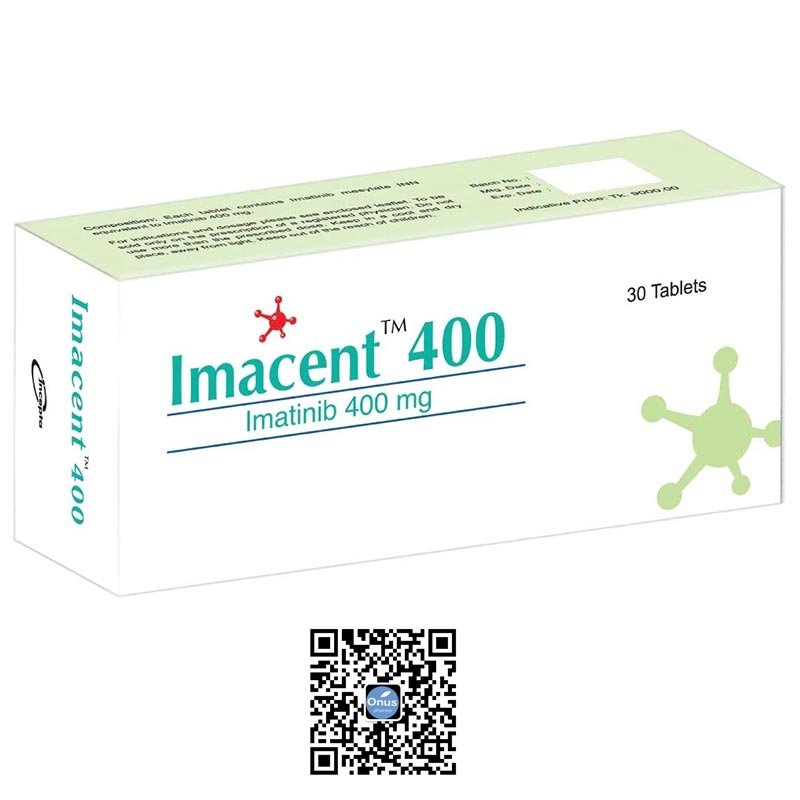
Before confirming Imacent(imatinib) as your treatment
About the treatment milestones — understanding what success looks like
About dosing and administration
About fluid retention — the most distinctive monitoring requirement
About blood count monitoring
About liver monitoring
About muscle cramps — a commonly underestimated side effect
About managing nausea
About the warfarin and medication interaction
About my specific situation
About the long-term picture — treatment-free remission
About the longer road
A practical tip: Because CML is a long-term, often decades-long treatment relationship, the milestone conversation — specifically knowing exactly which BCR-ABL percentage you need to hit at 3 months, 6 months, and 12 months — is worth asking for in writing at your first appointment. Many patients on imatinib find that having their own printed monitoring schedule helps them stay engaged with their treatment response over the long term, rather than waiting passively for results to be interpreted at appointments.
This is one of the most nuanced treatment decisions in hematologic oncology — three approved first-line options with meaningfully different efficacy, side-effect profiles, and long-term implications, including the increasingly important question of which drug best positions a patient for eventual treatment-free remission.
What they are and how they differ mechanistically
| Imatinib (Imacent) | Dasatinib (Sprycel) | Nilotinib (Tasigna) | |
|---|---|---|---|
| Generation | 1st | 2nd | 2nd |
| BCR-ABL binding | Type II — binds inactive conformation | Type I — binds active and inactive | Type II — binds inactive conformation |
| Potency vs imatinib | Reference | ~325x more potent in vitro | ~30x more potent in vitro |
| Additional kinase targets | KIT, PDGFR, ABL | KIT, PDGFR, SRC family kinases | KIT, PDGFR |
| SRC kinase inhibition | No | Yes — additional mechanism | No |
| T315I mutation coverage | No | No (dasatinib covers some other resistant mutations) | No |
| Approved first-line | 2001 | 2010 | 2010 |
| Generic available | Yes — widely and affordably | Limited | Limited |
The type I vs type II binding distinction matters clinically — dasatinib’s ability to bind both active and inactive conformations of BCR-ABL, plus its SRC kinase inhibition, gives it a slightly broader mechanism and better CNS penetration than the other two.
The pivotal head-to-head trials
All three drugs were compared against imatinib in large randomized trials in newly diagnosed chronic-phase CML:
| Trial | Comparison | Key PFS/Response finding |
|---|---|---|
| IRIS | Imatinib vs interferon (historical) | Established imatinib as standard |
| DASISION | Dasatinib vs imatinib | Faster and deeper molecular responses with dasatinib; similar OS at 5 years |
| ENESTnd | Nilotinib vs imatinib | Faster and deeper molecular responses with nilotinib; fewer progressions to accelerated/blast phase |
The consistent finding across DASISION and ENESTnd: both second-generation drugs achieve faster and deeper molecular responses than imatinib — meaning BCR-ABL levels fall more quickly and to lower levels. However, long-term overall survival has not been shown to be definitively superior for either second-generation drug over imatinib in the chronic phase setting, partly because patients who develop resistance on imatinib can often be switched successfully to a second-generation TKI.
Molecular response depth and treatment-free remission implications
This is where the comparison has evolved most significantly in recent years. Treatment-free remission — the possibility of stopping therapy entirely while maintaining undetectable BCR-ABL — has become an explicit treatment goal for many patients, particularly younger ones.
Achieving the deep molecular responses required for treatment-free remission attempts (MR4 or MR4.5 — BCR-ABL undetectable or below 0.01% on the International Scale) happens faster and more frequently with second-generation TKIs than with imatinib. Long-term data suggest:
For a younger patient with a treatment-free remission goal — whether for family planning, quality of life, or simply the desire to stop lifelong therapy — this difference meaningfully favors starting with a second-generation TKI.
Side effect comparison — the most practically important differences
| Side effect | Imatinib | Dasatinib | Nilotinib |
|---|---|---|---|
| Fluid retention / edema | Common — periorbital, peripheral | Less common in general; pleural effusion is distinctive | Less common than imatinib |
| Pleural effusion | Rare | More common — 10-28% (fluid around lungs) — distinctive to dasatinib | Rare |
| Nausea / GI effects | More prominent | Less prominent | Moderate |
| Muscle cramps | Common — distinctive to imatinib | Less common | Less common |
| Cardiovascular events | Less prominent | Pulmonary arterial hypertension (rare but serious) | Arterial occlusive events — peripheral artery disease, heart attack, stroke |
| QTc prolongation | Less prominent | Less prominent | More prominent — monitoring required |
| Hyperglycemia | Less common | Less common | More common — diabetes risk |
| Hepatotoxicity | Present | Present | Present — more prominent |
| CNS penetration | Limited | Better — relevant for blast crisis with CNS involvement | Limited |
| Food restrictions | None — taken with food | None | Must be taken on empty stomach — 2 hours after and 1 hour before food |
The cardiovascular difference — clinically the most important safety distinction
Nilotinib’s association with arterial occlusive events — peripheral artery disease, myocardial infarction, and stroke — is the most important long-term safety signal in this comparison. These events appear to increase with duration of nilotinib exposure and are more frequent than with imatinib or dasatinib. For patients with pre-existing cardiovascular risk factors (diabetes, hypertension, hyperlipidemia, smoking history, prior cardiac events), this risk profile meaningfully changes the calculus toward imatinib or dasatinib.
Dasatinib’s pleural effusion risk is the equivalent concern for that drug — fluid accumulation around the lungs that can range from asymptomatic (found on routine imaging) to causing significant breathlessness requiring treatment interruption, diuretics, or corticosteroids. For patients with pre-existing lung disease, this is a relevant consideration.
Dosing and practical differences
| Imatinib | Dasatinib | Nilotinib | |
|---|---|---|---|
| Dose | 400mg once daily | 100mg once daily | 300mg twice daily |
| With food | Required — reduces nausea | With or without food | Empty stomach required — strict rule |
| Pill burden | 1 tablet | 1 tablet | 2 tablets twice daily (4 total/day) |
| QTc monitoring | Not required | Not required | Required — baseline and periodic ECG |
Nilotinib’s twice-daily empty-stomach requirement — similar in principle to abiraterone’s food restriction — is a real adherence consideration. Taking it with food can significantly alter drug exposure, and remembering to take it twice daily on an empty stomach is a more demanding routine than imatinib’s or dasatinib’s once-daily approach.
Risk stratification — how Sokal/ELTS score influences the choice
A patient’s Sokal or ELTS risk score (calculated from age, spleen size, platelet count, and blast percentage at diagnosis) helps guide the first-line choice:
How the practical choice typically unfolds
Imatinib tends to be preferred when:
Dasatinib tends to be preferred when:
Nilotinib tends to be preferred when:
Bottom line
This comparison doesn’t have a single right answer — it’s one of the most genuinely individualized treatment decisions in hematology. The three drugs are all legitimate first-line options with decades of supporting data. The key variables that tend to resolve the choice are: cardiovascular risk (favors imatinib or dasatinib over nilotinib), treatment-free remission as an explicit priority (favors second-generation), cost and access (favors imatinib), pre-existing lung disease (favors imatinib or nilotinib over dasatinib), and adherence to complex dosing rules (favors imatinib or dasatinib over nilotinib’s twice-daily empty-stomach requirement). Mapping these against your specific risk score and long-term goals with your hematologist is the essential conversation.
Treatment-free remission (TFR) is one of the most remarkable developments in modern oncology — the possibility that patients with a disease that once required lifelong therapy might be able to stop treatment entirely and remain in remission. It’s also one of the most carefully managed decisions in hematology, because the eligibility criteria and monitoring requirements are specific and non-negotiable.
What treatment-free remission actually means
TFR doesn’t mean the cancer is cured — residual CML cells almost certainly remain in most patients who stop therapy, at levels below the detection threshold of current tests. What it means is that the immune system, in concert with the deep suppression achieved by TKI therapy, is able to keep those remaining cells in check without ongoing drug treatment.
The distinction matters because TFR attempts are managed as a controlled withdrawal under close molecular monitoring — not as a declaration that treatment is finished. If BCR-ABL levels rise above a defined threshold after stopping, TKI therapy is restarted promptly, and the vast majority of patients who lose remission regain it on restarting — making TFR attempts generally safe when managed properly.
The evidence base — key TFR trials
The concept emerged from the STIM trial (2010), which first demonstrated that carefully selected CML patients could stop imatinib and maintain undetectable BCR-ABL. Subsequent trials refined the eligibility criteria and confirmed the findings:
Eligibility criteria — what needs to be true before attempting TFR
The criteria used across major trials and now reflected in NCCN and ELN guidelines are:
Duration of TKI therapy: Most guidelines require at least 5 years of total TKI therapy before a TFR attempt. This ensures sufficient treatment duration to achieve durable disease control.
Depth of molecular response: The patient must have achieved and sustained MR4 (BCR-ABL ≤0.01% on the International Scale) or preferably MR4.5 (BCR-ABL ≤0.0032% or undetectable with sufficient sensitivity). A single measurement is not sufficient — sustained response over time is required.
Duration of deep molecular response: Most guidelines require at least 2 years of sustained MR4 or deeper response before stopping. EURO-SKI data showed that the longer the duration of deep molecular response before stopping, the higher the likelihood of maintaining TFR.
Chronic phase only: TFR is not currently recommended for patients who have been in accelerated or blast phase.
Molecular monitoring capability: The patient must have access to a laboratory that can perform sensitive quantitative PCR testing (capable of detecting BCR-ABL at MR4.5 levels) and must commit to frequent monitoring after stopping.
No prior TKI resistance: Patients who switched TKIs due to resistance (rather than intolerance) generally have lower TFR success rates.
What the monitoring schedule looks like after stopping
This is where TFR diverges most sharply from simply “finishing” a medication. The monitoring intensity after stopping is higher than during stable treatment:
This frequency reflects the fact that most molecular relapses — approximately 50–60% of all relapses — occur within the first 6 months after stopping. The early intensive monitoring catches these quickly, allowing prompt TKI restart before any clinical progression occurs.
What constitutes molecular relapse — when TKI restarts
Different guidelines use slightly different thresholds, but the most commonly used criterion is:
At the point of molecular relapse, TKI therapy is restarted — typically at the same dose as before stopping. The critical reassurance from trial data is that the vast majority (>95%) of patients who lose TFR regain deep molecular response on restarting — meaning a failed TFR attempt does not permanently compromise the patient’s disease control.
Who is most likely to succeed at TFR
EURO-SKI and other analyses have identified several factors associated with higher TFR success:
There is also emerging evidence that immune system factors — specifically natural killer (NK) cell function — play a role in maintaining TFR, which helps explain why some patients with seemingly equivalent disease control maintain TFR while others relapse.
The TFR attempt as a conversation, not just a decision
One important practical point: TFR attempts require explicit patient commitment to the monitoring schedule. A patient who stops imatinib and then misses monthly PCR tests is not in a managed TFR — they’re simply off treatment without safety monitoring. This is why TFR is always described as an “attempt” with a structured protocol rather than simply stopping the medication.
The conversation with your hematologist should specifically cover: which laboratory will do the PCR testing, what level of sensitivity that lab can reliably detect, what the specific restart threshold is, and what the plan is if you miss a monitoring appointment.
Practical implications — why this matters for treatment choice at diagnosis
This context connects back to the imatinib vs dasatinib vs nilotinib comparison: for a newly diagnosed patient with TFR as an explicit long-term goal — particularly younger patients who want the option of stopping therapy before or after having children — choosing a second-generation TKI from the outset may reach the depth of response needed for TFR eligibility faster. For a patient where TFR isn’t a priority (older patient with good imatinib tolerance, cost constraints, or comorbidities that make second-generation TKIs less appropriate), imatinib remains an entirely legitimate path to TFR — just potentially a longer one.
Conatact US