Address
Sector 14, Road no. 18, Uttara, 1230
Dhaka, Bangladesh
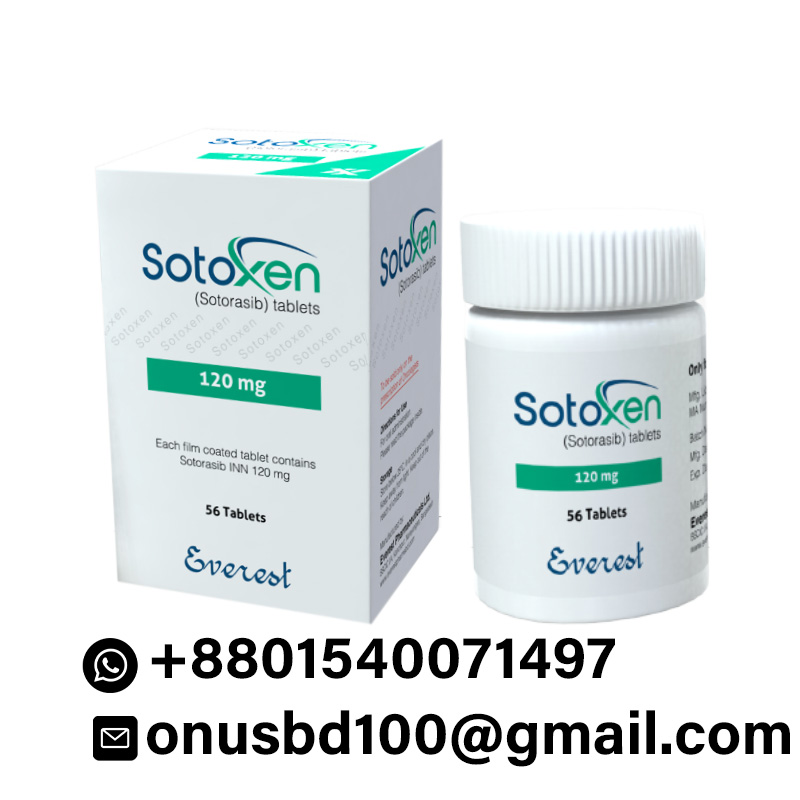
Rx Prescripttion Only-YMYL Medical Content
Indicated for adults with KRAS G12C-mutated locally advanced or metastatic non-small cell lung cancer (NSCLC), as determined by an FDA-approved test, who have received at least one prior systemic therapy. Also approved (in combination with panitumumab) for KRAS G12C-mutated metastatic colorectal cancer after prior fluoropyrimidine-, oxaliplatin-, and irinotecan-based chemotherapy.
1
2
3
4
MD
Medical Oncologist Review
Board-certified oncologist · 12+ years in thoracic malignancies
Content reviewed against FDA prescribing information, NCCN Guidelines v2.2024, and published Phase III trial data. Last updated June 2026.
These steps help you have an informed conversation. A confirmed EGFR mutation result is the starting point for any treatment decision.
Medical disclaimer: This page is for informational purposes only and does not constitute medical advice, diagnosis, or treatment. It is a prescription medication that must only be used under the supervision of a qualified oncologist. Clinical outcomes data is drawn from published Phase III trials; individual results vary. Always consult your healthcare provider and refer to the full prescribing information before making any treatment decisions. Emergency: call your local emergency services or poison control immediately if you experience serious adverse effects.
Here are key questions to bring to your oncologist — given that sotorasib targets a highly specific mutation that must be confirmed before treatment, involves eight tablets per dose that could easily be miscounted, and carries liver monitoring requirements that should be scheduled before starting, these three areas deserve the most focused pre-treatment conversation.
Before confirming sotorasib as your treatment
About the dosing — confirm this precisely before starting
About liver monitoring — schedule before your first dose
About ILD/pneumonitis
About diarrhea — the most common side effect
About musculoskeletal pain
About drug interactions
About pneumonia risk
About the accelerated approval status
About contraception
About monitoring response
About the longer road
A practical tip: The dosing confusion risk with sotorasib is higher than with almost any other drug in this series — eight 120mg tablets as a single daily dose is an unusual regimen, and both patients and pharmacists can easily miscalculate this. Ask your oncologist to write the dose as “960mg (eight 120mg tablets) once daily” on every prescription, and confirm this explicitly with your pharmacist at every refill to ensure you’re dispensing and taking the correct number of tablets each day.
This comparison sits in genuinely interesting evidentiary territory — two drugs targeting the same mutation through the same general mechanism, both approved, but with meaningfully different molecular designs and somewhat different clinical data profiles that are still being actively refined.
Both are covalent KRAS G12C inhibitors — same target, different chemistry
| Sotorasib (Lumakras) | Adagrasib (Krazati) | |
|---|---|---|
| Manufacturer | Amgen | Mirati Therapeutics (now BMS) |
| FDA approval | May 2021 (accelerated) | December 2022 (accelerated) |
| Dosing | 960mg once daily | 600mg twice daily |
| Pivotal trial | CodeBreaK 100 | KRYSTAL-1 |
| Half-life | ~5 hours | ~23 hours |
Both drugs form irreversible covalent bonds with the mutant cysteine at KRAS G12C position 12 and lock the protein in its inactive GDP-bound state — the same fundamental mechanism we just described. The differences lie in their molecular chemistry, pharmacokinetics, and resulting clinical profiles.
Efficacy — broadly comparable with important nuances
Phase II data for sotorasib demonstrated a 37.1% overall response rate. Adagrasib demonstrated a 45% ORR in an early study. A cross-trial comparison of these numbers is useful but imperfect — different trial populations, different prior treatment requirements, and different enrollment criteria mean this isn’t a head-to-head result.
The most meaningful direct comparison comes from CodeBreaK 200, which randomized sotorasib against docetaxel and showed PFS improvement for sotorasib. For adagrasib, KRYSTAL-1 similarly showed clinically meaningful activity. No dedicated head-to-head trial comparing these two drugs directly has been completed and reported with mature data.
CNS activity — adagrasib has a potentially meaningful advantage
This is where the two drugs most clearly diverge in clinical relevance. KRAS G12C-mutated NSCLC has a meaningful rate of CNS metastases, and adagrasib’s longer half-life and different pharmacokinetic profile contribute to demonstrably better CNS penetration than sotorasib. KRYSTAL-1 included a dedicated CNS cohort showing meaningful intracranial responses in patients with active brain metastases — an efficacy dimension that sotorasib’s trials were not designed to characterize as extensively.
For patients with known or suspected CNS involvement, this pharmacokinetic difference is clinically relevant — adagrasib’s twice-daily dosing and longer half-life maintain more sustained CNS drug concentrations than sotorasib’s once-daily shorter half-life profile.
Side effects — overlapping profiles with some differences
Both drugs produce broadly similar adverse event patterns — diarrhea, nausea, vomiting, fatigue, and hepatotoxicity are shared across both. The differences are in relative frequency and specific patterns rather than fundamentally different toxicity categories.
Adagrasib’s twice-daily dosing maintains higher sustained drug exposure, which may contribute to more frequent GI adverse events and more prominent QTc prolongation — a cardiac monitoring requirement that sotorasib doesn’t carry to the same degree. Sotorasib’s once-daily dosing provides lower peak-to-trough fluctuation but may contribute to more hepatotoxicity signal in some analyses.
Both drugs require liver function monitoring, though the schedules differ somewhat between the prescribing information documents.
Drug interaction profiles — a meaningful practical difference
Both drugs affect CYP3A4 metabolism and P-glycoprotein substrates, as we discussed on the Sotoxen page. Adagrasib has a more extensive and clinically significant drug interaction profile, including inhibition of CYP3A4, CYP2D6, and P-gp simultaneously — meaning patients on medications metabolized by any of these pathways require more careful review before starting adagrasib than sotorasib.
Dosing convenience — a genuine practical consideration
Sotorasib’s once-daily dosing is simpler in schedule, but requires eight 120mg tablets per dose — a high pill burden that requires clear patient education to avoid underdosing. Adagrasib’s twice-daily 600mg dose requires fewer tablets but introduces a twice-daily schedule. For patients where adherence to complex regimens is a concern, these are genuine trade-offs worth discussing explicitly.
The combination landscape — where the field is heading
Neither drug has demonstrated the kind of single-agent survival benefit that would clearly establish it as definitively superior to the other. The more active research direction is combination therapy — pairing KRAS G12C inhibitors with drugs targeting feedback reactivation pathways, EGFR, SOS1, SHP2, MEK, and checkpoint immunotherapy. Both sotorasib and adagrasib are being studied in combination regimens, and the combination of sotorasib with panitumumab has already received FDA approval for KRAS G12C-mutated colorectal cancer, suggesting that combination approaches rather than single-agent refinement may define the next generation of KRAS G12C-directed therapy.
The adagrasib regulatory update — worth acknowledging
Adagrasib’s accelerated approval, like sotorasib’s, was based on response rate rather than confirmed survival benefit. Both drugs remain under scrutiny for their confirmatory trial data, and the field’s understanding of where each fits optimally in treatment sequencing — particularly relative to immunotherapy combinations that have become standard first-line for many KRAS G12C-mutated NSCLC patients — continues to evolve.
Bottom line
This is one of the most compelling stories in modern oncology — a problem that resisted solution for nearly 40 years, solved by a structural insight so elegant that it changed how the field thinks about what “undruggable” actually means.
What KRAS is and why it matters so much
KRAS is one of the most important signaling proteins in human cell biology — a molecular switch that normally cycles between an active “on” state (bound to GTP) and an inactive “off” state (bound to GDP). When a growth signal arrives at the cell surface, KRAS switches to its GTP-bound active form, relays the growth signal downstream through pathways including RAF-MEK-ERK and PI3K-AKT, then hydrolyzes GTP back to GDP and returns to its inactive state. This on/off cycling is tightly regulated in normal cells.
KRAS mutations are the most common oncogenic driver mutations in human cancer overall — found in approximately 25% of all cancers, with particularly high prevalence in pancreatic cancer (~90%), colorectal cancer (~45%), and non-small cell lung cancer (~30%). The KRAS G12C mutation specifically — a glycine-to-cysteine substitution at position 12 — is found in approximately 13% of NSCLC adenocarcinomas, making it one of the most common targetable mutations in lung cancer.
Why KRAS mutations drive cancer
When KRAS is mutated at position 12 (where glycine is replaced by another amino acid), the protein’s ability to hydrolyze GTP back to GDP is impaired. The mutant KRAS becomes stuck in its GTP-bound active state — permanently firing growth and survival signals downstream regardless of whether any external growth signal has actually arrived. The cancer cell essentially has its growth accelerator locked in the “on” position at the molecular level.
Why KRAS was considered undruggable for nearly 40 years
This is the heart of the story, and it requires understanding what made KRAS structurally resistant to the conventional drug design approaches that had succeeded for other oncogenic kinases like EGFR, ALK, and BCR-ABL.
No obvious binding pocket — most successfully drugged kinases have a well-defined ATP-binding pocket that small molecules can occupy, blocking the enzyme’s catalytic activity. KRAS’s GTP-binding site is so small, so smooth, and binds GTP with such extraordinarily high affinity (in the picomolar range) that designing a small molecule to compete with GTP for this site was considered essentially impossible — the drug would be outcompeted by the cell’s abundant intracellular GTP at any achievable drug concentration.
No known allosteric pocket — unlike some enzymes that have secondary regulatory sites where drugs can bind and change the protein’s shape from a distance, early structural studies of KRAS didn’t reveal any obvious alternative binding site accessible to small molecules.
High binding affinity for GTP — KRAS binds GTP so tightly that even if a drug could reach the GTP-binding site, displacing the already-bound GTP was considered mechanistically infeasible at physiologically achievable drug concentrations.
These three combined structural features meant that for nearly four decades after KRAS mutations were first identified as oncogenic drivers in the early 1980s, every attempt to directly drug KRAS failed — leading the oncology field to broadly classify KRAS as undruggable and focus attention on blocking downstream effectors (MEK, ERK, RAF) rather than KRAS itself.
The breakthrough insight — the switch-II pocket and the G12C cysteine
The solution, when it finally emerged from structural biology work published around 2013 and refined through the following years, came from two converging insights:
The cysteine at position 12 is chemically unique and reactive — the G12C mutation specifically replaces glycine with cysteine, and cysteine is notable among amino acids for containing a sulfhydryl (-SH) group that is electrophilic and capable of forming covalent bonds with appropriate chemical partners. This reactive cysteine sits adjacent to a previously unappreciated shallow pocket in the protein’s surface — the switch-II pocket — that is only accessible when KRAS is in its inactive, GDP-bound state.
The switch-II pocket exists only in the inactive GDP-bound conformation — this is the critical structural insight. When KRAS is in its active GTP-bound state, the switch-II region of the protein is conformationally different, and this pocket doesn’t exist in accessible form. When KRAS is in its inactive GDP-bound state, the switch-II pocket opens up, becoming accessible to small molecules.
How sotorasib exploits both of these features simultaneously
Sotorasib is an inhibitor of KRAS G12C, a tumor-restricted, mutant-oncogenic form of the RAS GTPase. It works by forming an irreversible covalent bond with the mutant cysteine at position 12 — specifically targeting the GDP-bound, inactive form of KRAS G12C. By occupying the switch-II pocket and covalently bonding to the G12C cysteine, sotorasib locks KRAS in its inactive GDP-bound state, preventing it from exchanging GDP for GTP and switching to its active signaling-competent form.
This mechanism is elegantly suited to the problem: rather than trying to compete with GTP for the primary binding site (the approach that failed for decades), sotorasib attacks a secondary pocket that is only accessible in the inactive state, and uses an irreversible covalent bond to the mutant cysteine so that once bound, it cannot be displaced. The protein is permanently locked in its “off” state.
Why this approach specifically spares normal KRAS
This is the feature that makes sotorasib’s mechanism not just clever but genuinely tumor-selective. Normal wild-type KRAS has glycine at position 12 — not cysteine. Without the cysteine, sotorasib cannot form its covalent bond and has essentially no activity against normal KRAS. The drug is inherently selective for the mutant protein specifically, not the wild-type protein that normal cells depend on for their own legitimate growth signaling. This tumor-restricted selectivity is a primary reason sotorasib’s side effect profile, while significant, is different from the broad toxicities of chemotherapy or even many kinase inhibitors that hit normal as well as abnormal targets.
What downstream pathways get shut down
When sotorasib locks KRAS G12C in its inactive GDP-bound state, it prevents downstream activation of the RAF-MEK-ERK signaling cascade and the PI3K-AKT-mTOR pathway — two of the most fundamental cell growth and survival circuits in cancer biology. With both of these pathways deprived of the constitutively active KRAS signal that was driving them, the KRAS-addicted cancer cells lose the abnormal growth and survival advantage that had been sustaining them.
Why the 36% response rate is meaningful in context
The 36% overall response rate in CodeBreaK 100 — in a heavily pretreated patient population that had already failed prior systemic therapy including often platinum-based chemotherapy and immunotherapy — is best understood in context. This wasn’t a biomarker-unselected population receiving a generic treatment; it was a precisely biomarker-selected population receiving the first drug ever designed to target the molecular driver specifically responsible for their cancer. The responses that occurred were real, measurable tumor shrinkages in a population with limited remaining options.
Why the accelerated approval reflects a still-evolving picture
The FDA’s accelerated approval reflects that CodeBreaK 100 was a single-arm trial measuring response rate rather than a randomized trial demonstrating survival benefit. The subsequent CodeBreaK 200 trial — randomized against docetaxel — showed improvement in progression-free survival, but the FDA issued a Complete Response Letter declining full approval and requesting an additional confirmatory study, reflecting ongoing questions about the magnitude of benefit relative to active comparators in a modern treatment landscape that includes immunotherapy combinations. This doesn’t diminish the biological and clinical significance of sotorasib’s mechanism, but it does mean the drug’s definitive place in NSCLC treatment sequencing continues to be refined.
The bigger picture
Sotorasib’s mechanism represents the resolution of a 40-year pharmacological impasse through structural biology — finding a binding site that nobody had successfully exploited, using a mutation-specific chemical reactivity that normal proteins lack, and locking the target in its inactive rather than active state through irreversible covalent bonding. The approach validated not just this specific drug but an entire conceptual framework: “undruggable” often means “we haven’t found the right pocket yet,” and the switch-II pocket insight has opened a broader research program into KRAS and RAS family inhibition that is still rapidly expanding, including the development of adagrasib and next-generation KRAS inhibitors that are now entering clinical practice alongside sotorasib.
Conatact US