Address
Sector 14, Road no. 18, Uttara, 1230
Dhaka, Bangladesh
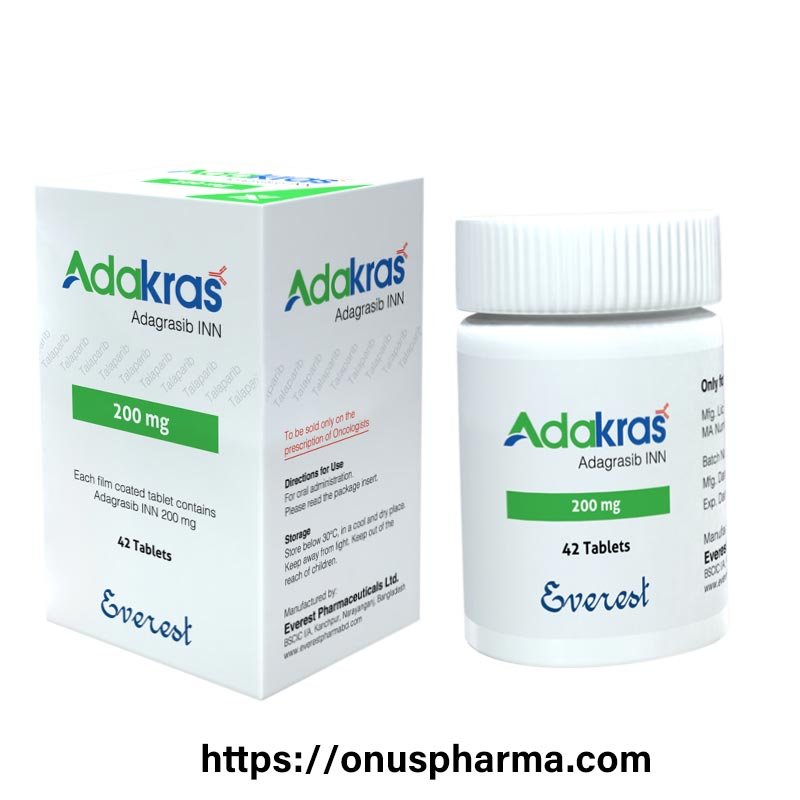
Rx Prescripttion Only-YMYL Medical Content
Approved for adults with KRAS G12C-mutated locally advanced or metastatic non-small cell lung cancer (NSCLC) who have received at least one prior systemic therapy, and for KRAS G12C-mutated metastatic colorectal cancer (in combination with cetuximab) after prior fluoropyrimidine-, oxaliplatin-, and irinotecan-based chemotherapy.
1
2
3
4
MD
Medical Oncologist Review
Board-certified oncologist · 12+ years in thoracic malignancies
Content reviewed against FDA prescribing information, NCCN Guidelines v2.2024, and published Phase III trial data. Last updated June 2026.
These steps help you have an informed conversation. A confirmed EGFR mutation result is the starting point for any treatment decision.
Medical disclaimer: This page is for informational purposes only and does not constitute medical advice, diagnosis, or treatment. It is a prescription medication that must only be used under the supervision of a qualified oncologist. Clinical outcomes data is drawn from published Phase III trials; individual results vary. Always consult your healthcare provider and refer to the full prescribing information before making any treatment decisions. Emergency: call your local emergency services or poison control immediately if you experience serious adverse effects.
Before confirming adagrasib as your treatment
About drug interactions — critically important for this drug
About liver and heart monitoring
About the dosing schedule
About managing GI side effects
About lung-related symptoms
About my specific situation
About the longer road
A practical tip: Because the drug interaction list is unusually long for this medication, it’s worth bringing a complete written list of everything you take — including supplements — to this appointment specifically, rather than relying on memory. Some interactions require timing adjustments rather than stopping a medication entirely, so your oncologist and pharmacist may need to work out a schedule together.
Both adagrasib and sotorasib are KRAS G12C inhibitors with overlapping indications, and — notably — neither has been tested directly against the other in a head-to-head trial. Here’s how they compare based on current data:
Approval timeline and indications
| Sotorasib (Lumakras) | Adagrasib (Adakras) | |
|---|---|---|
| Manufacturer | Amgen | Mirati Therapeutics / Bristol Myers Squibb |
| First approved | 2021 (NSCLC) | 2022 (NSCLC) |
| NSCLC indication | KRAS G12C-mutated NSCLC after ≥1 prior therapy | Same |
| CRC indication | In combination with panitumumab, for metastatic colorectal cancer with the KRAS G12C mutation, previously treated with fluoropyrimidine-, oxaliplatin-, and irinotecan-based chemotherapy | In combination with cetuximab, for KRAS G12C-mutated metastatic colorectal cancer with similar prior chemotherapy requirements |
| CRC approval type | First approval for chemorefractory KRAS G12C-mutated metastatic colorectal cancer,based on a phase III trial | First KRAS-targeting drug approved for colorectal cancer overall, via accelerated approval |
This is the most important update since our last conversation: both drugs now have FDA-approved colorectal cancer indications, each paired with a different EGFR-targeting antibody (panitumumab for sotorasib, cetuximab for adagrasib).
Dosing — a major day-to-day difference
| Sotorasib | Adagrasib | |
|---|---|---|
| Dose | 960mg once daily | 600mg twice daily |
| Pill burden | Typically 8 tablets (120mg each), once daily | Typically 3 tablets (200mg each) per dose, twice daily |
| Half-life | Shorter | Longer |
Sotorasib’s once-daily dosing means fewer total daily “events” but a high pill count at once; adagrasib’s twice-daily schedule spreads the pills out but means remembering doses morning and evening.
Efficacy in lung cancer
Both drugs showed broadly similar results in their pivotal NSCLC trials — response rates in the 37–43% range and progression-free survival in the 5–6.5 month range. Neither drug demonstrated an overall survival advantage over chemotherapy (docetaxel) in their respective phase III trials, which is an important honest point: these inhibitors as monotherapy in second-line treatment generally have relatively modest objective response rates and progression-free survival compared with other targeted therapies, and failed to demonstrate improvement in overall survival compared with docetaxel in phase III studies, largely due to resistance developing over time.
Efficacy in colorectal cancer — both drugs underperform here
This is a critical point for anyone with KRAS G12C-mutated CRC specifically: while both sotorasib and adagrasib showed efficacy in NSCLC, they were considerably less effective for colorectal cancer patients with the same mutation, which is why both are approved only in combination with an EGFR-blocking antibody for CRC, never as monotherapy.
For sotorasib + panitumumab (CodeBreaK 300), 26% of patients treated with the approved 960mg dose experienced a treatment response, compared with 0% on standard-of-care — a meaningful improvement over nothing, but still a modest absolute response rate.
For adagrasib + cetuximab, direct trial-by-trial efficacy figures are available from KRYSTAL-1, though as research reviewers note, we currently do not have clinical trials or real-world data directly comparing the efficacy of adagrasib to sotorasib in this setting, and any cross-trial comparison suggesting one numerically outperforms the other should be read cautiously given the differences in trial design.
A phase III trial (KRYSTAL-10) comparing adagrasib plus cetuximab against standard chemotherapy in second-line KRAS G12C-mutated colorectal cancer is underway, with results expected in 2026 — so the evidence picture for adagrasib in CRC is still maturing relative to sotorasib’s completed phase III data.
Why both underperform in CRC
The shared explanation across both drugs comes down to EGFR pathway feedback — when KRAS G12C is blocked, colorectal cancer cells can reactivate growth signals through EGFR, essentially routing around the blockade. This is why combined KRAS G12C and EGFR inhibition — whether sotorasib-panitumumab, adagrasib-cetuximab, or other combinations in development — has shown greater efficacy than KRAS G12C inhibitor monotherapy, and supports this combination approach as the standard regimen for this population.
Side effect profiles
Both drugs share a broadly similar adverse event pattern — GI toxicity (diarrhea, nausea), hepatotoxicity requiring liver monitoring, and some cardiac (QT-related) considerations. Adagrasib’s longer half-life and more complex drug-metabolism interactions (which we discussed earlier) are generally considered more pronounced than sotorasib’s, making the medication review conversation particularly important if adagrasib is being considered.
Where CRC patients now stand vs. before
Before these approvals, options for KRAS G12C-mutated CRC after standard chemo were limited to non-targeted late-line therapies — prior to this approval, standards of care included trifluridine/tipiracil and regorafenib, which yielded positive but limited survival outcomes — drugs we discussed earlier in this conversation. Both new combinations represent a step forward, though the absolute benefit (around a quarter of patients responding) means expectations should be calibrated honestly.
Bottom line
For NSCLC, the two drugs are largely interchangeable in efficacy, with the choice often coming down to dosing preference (once-daily/high pill count vs. twice-daily) and drug interaction considerations. For CRC, both are now viable — sotorasib+panitumumab has completed phase III data supporting its approval, while adagrasib+cetuximab’s confirmatory phase III data (KRYSTAL-10) is still pending results expected in 2026. Your oncologist’s experience with each combination, your specific medication list (given adagrasib’s interaction profile), and which EGFR-antibody partner (cetuximab vs panitumumab) your treatment center is set up to administer may all factor into which combination is recommended.
KRAS G12C testing follows the same general logic as the EGFR, FLT3, BCR-ABL, and PIK3CA/AKT1/PTEN testing we’ve discussed — but KRAS testing has one notable historical wrinkle: for decades, KRAS mutations were tested mainly to exclude patients from EGFR-targeted therapies (since KRAS-mutant tumors don’t respond to EGFR inhibitors), not to select them for a KRAS-targeted drug. That changed only recently with adagrasib and sotorasib.
What’s being tested
KRAS G12C is a single, specific point mutation — a substitution at codon 12 of the KRAS gene where glycine is replaced by cysteine. This is just one of many possible KRAS mutations (others include G12D, G12V, G13D, and more), and only G12C is targetable by adagrasib or sotorasib. The other KRAS mutations remain largely untargeted by approved drugs, though some are in earlier-stage development (as we touched on with the KRAS-G12D inhibitor mentioned in research).
This specificity is important: a tumor that’s broadly “KRAS-mutant” doesn’t qualify for these drugs — it has to be the G12C variant specifically.
Sample source
Both tissue and blood-based testing are used:
Tumor tissue — from a biopsy or surgical specimen, either archival or fresh, is the traditional source and allows broad genomic profiling alongside other relevant markers (PD-L1, other co-mutations like STK11 or KEAP1 that affect prognosis).
Liquid biopsy (blood-based ctDNA) — increasingly used, especially when tissue is limited or a fresh biopsy isn’t practical. This was validated as part of the companion diagnostic pathways for both adagrasib and sotorasib.
How the lab analyzes it
Timeline
Similar to other NGS-based testing: tissue-based comprehensive panels typically take 1–3 weeks, while liquid biopsy results often return in 1–2 weeks. Since KRAS testing is usually bundled into a broad genomic panel done at diagnosis (rather than ordered as a standalone test later), many patients already have this information available by the time treatment decisions are being made — unlike, say, T790M testing in EGFR-mutated lung cancer, which is specifically triggered by disease progression.
What the result means for treatment
| Result | What it typically means |
|---|---|
| KRAS G12C detected | Adagrasib or sotorasib become potential options (NSCLC monotherapy, or combination therapy for CRC) |
| KRAS mutation detected, but not G12C (e.g., G12D, G12V) | Neither approved KRAS G12C inhibitor applies; other treatment lines considered, though clinical trials for other KRAS variants are an active research area |
| KRAS wild-type (no mutation) | KRAS-targeted therapy not relevant; other biomarkers (EGFR, ALK, PD-L1, etc.) guide treatment |
A practical nuance
Because KRAS testing is usually part of a broad upfront panel rather than a separately-ordered test, it’s worth specifically checking your original pathology or molecular report for the exact KRAS mutation listed — not just “KRAS mutation positive” or “KRAS mutation negative.” If the report says something general without specifying G12C versus another variant, that’s worth clarifying with your oncologist, since it directly determines whether adagrasib or sotorasib are even on the table.
Conatact US