Address
Sector 14, Road no. 18, Uttara, 1230
Dhaka, Bangladesh

Rx Prescripttion Only-YMYL Medical Content
Approved for adults with advanced renal cell carcinoma (kidney cancer / RCC) and for adults with advanced soft tissue sarcoma (STS) who have received prior chemotherapy — excluding adipocytic STS and gastrointestinal stromal tumors (GIST), which are not covered by this indication.
1
2
3
4
MD
Medical Oncologist Review
Board-certified oncologist · 12+ years in thoracic malignancies
Content reviewed against FDA prescribing information, NCCN Guidelines v2.2024, and published Phase III trial data. Last updated June 2026.
These steps help you have an informed conversation. A confirmed EGFR mutation result is the starting point for any treatment decision.
Medical disclaimer: This page is for informational purposes only and does not constitute medical advice, diagnosis, or treatment. It is a prescription medication that must only be used under the supervision of a qualified oncologist. Clinical outcomes data is drawn from published Phase III trials; individual results vary. Always consult your healthcare provider and refer to the full prescribing information before making any treatment decisions. Emergency: call your local emergency services or poison control immediately if you experience serious adverse effects.
Here are key questions to bring to your oncologist — the liver monitoring plan and the medication review (especially statins) deserve the most attention before starting, given the boxed warning and the well-characterized 18-week hepatotoxicity window.
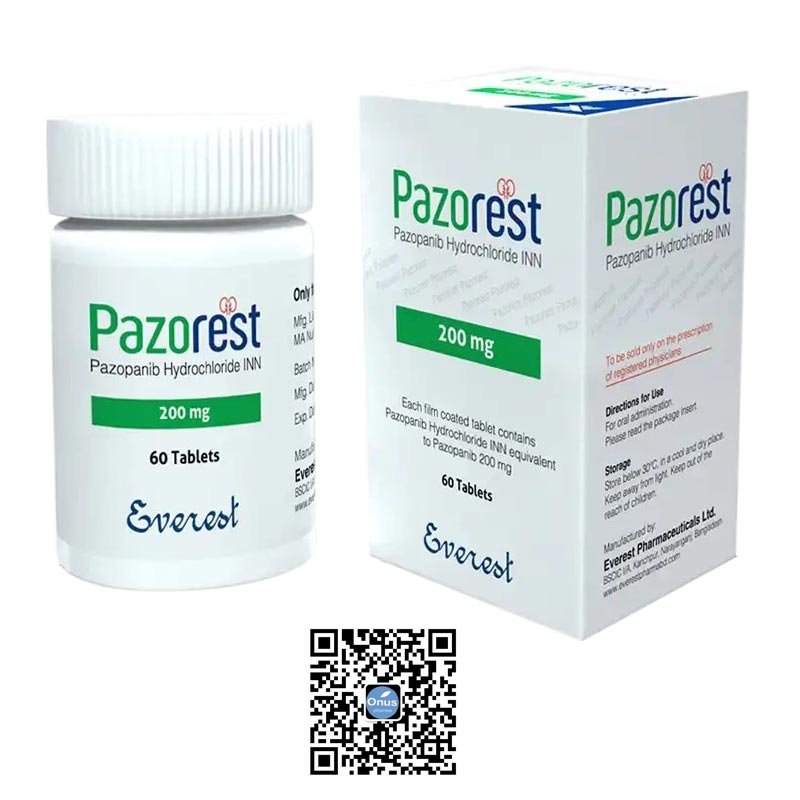
Before confirming Pazorest(Pazopanib Hydrochloride) as your treatment
About the boxed warning — liver toxicity
About the simvastatin interaction — critically important
About cardiovascular monitoring
About dosing and the empty stomach requirement
About managing common side effects
About proteinuria monitoring
About wound healing and surgical planning
About my specific situation
About response and the longer road
A practical tip: Because the liver enzyme elevation risk is heaviest in the first 18 weeks and is the drug’s most serious safety concern, it is worth asking for a written monitoring schedule before you start — specifically which weeks blood tests are planned, what results would trigger a call, and who to contact (oncology nurse, pharmacist, or physician directly) when results come back. Having this in writing removes ambiguity during a period when you’ll be receiving frequent lab results and may not always remember what the thresholds mean.
This is one of the most directly evidence-based comparisons in the entire kidney cancer treatment landscape — Pazopanib Hydrochloride and sunitinib were compared head-to-head in the COMPARZ trial, one of the largest oncology non-inferiority trials ever conducted, specifically designed to answer this question.
What they are and how they work
| Pazopanib Hydrochloride | Sunitinib | |
|---|---|---|
| Drug class | Multi-targeted TKI | Multi-targeted TKI |
| Key targets | VEGFR1/2/3, PDGFR-α/β, FGFR, c-Kit | VEGFR1/2/3, PDGFR-α/β, c-Kit, FLT3, RET, CSF-1R |
| Approved RCC | 2009 | 2006 |
| Manufacturer | Novartis | Pfizer |
Both work through broadly similar anti-angiogenic mechanisms — blocking VEGFR signaling to cut off the blood supply that feeds tumor growth. Sunitinib’s slightly broader kinase profile (including CSF-1R and FLT3) may contribute to some of its distinctive side effects compared to Pazopanib Hydrochloride.
The COMPARZ trial — the definitive head-to-head
COMPARZ enrolled 1,110 patients with previously untreated advanced clear-cell RCC and randomized them to either Pazopanib Hydrochloride or sunitinib. This was a non-inferiority design — the pre-specified question was whether pazopanib was at least as good as sunitinib, not whether it was better.
| Outcome | Pazopanib Hydrochloride | Sunitinib |
|---|---|---|
| Median PFS | 8.4 months | 9.5 months |
| Median OS | 28.4 months | 29.3 months |
| Objective response rate | 31% | 25% |
Pazopanib met the non-inferiority criterion for PFS — the confidence intervals crossed the pre-specified threshold — establishing it as a legitimate alternative to sunitinib rather than a step down. The numerical differences in PFS and OS between the two drugs were not statistically significant for superiority in either direction, and the response rate actually numerically favored pazopanib.
Dosing schedule — a meaningful practical difference
| Pazopanib | Sunitinib | |
|---|---|---|
| Dose | 800mg once daily, continuous | 50mg once daily, 4 weeks on / 2 weeks off (6-week cycle) |
| Schedule | Continuous — no planned breaks | Intermittent — 2 weeks off every 6 weeks |
| Food restriction | Empty stomach required | Can be taken with or without food |
The dosing difference is clinically and psychologically significant. Sunitinib’s 4-weeks-on/2-weeks-off schedule gives patients a predictable recovery period every cycle — many patients find this structure helpful for planning activities and recovering from side effects. Pazopanib’s continuous daily dosing means no built-in breaks, but also means side effects tend to be more consistent rather than cycling between worse (on treatment) and better (off treatment).
Side effect comparison — where the real difference lies
This is where COMPARZ’s quality-of-life sub-analyses became as important as the efficacy data:
| Side effect | Pazopanib | Sunitinib |
|---|---|---|
| Fatigue | Less pronounced | More pronounced — one of its most disabling features |
| Hand-foot skin reaction | Less common | More common and often more severe |
| Myelosuppression (low blood counts) | Less common | More common — particularly thrombocytopenia |
| Mucositis / mouth sores | Less common | More common |
| Hair depigmentation / color change | More common (~38%) | Less common |
| Hepatotoxicity (liver enzyme elevation) | More common — boxed warning | Less common |
| Hypertension | Common (~47%) | Common — similar incidence |
| Hypothyroidism | Present | More common — thyroid function monitoring essential |
| Diarrhea | Common (~52%) | Common — similar incidence |
| Nausea | Common | Common |
The COMPARZ quality-of-life analyses showed patients on pazopanib reported significantly better fatigue scores, fewer mouth sores, and less hand-foot skin reaction than those on sunitinib — while sunitinib patients had better scores on liver-related measures. A patient-preference study (PISCES) where patients were crossed over between both drugs found that 70% of patients preferred pazopanib over sunitinib when asked, primarily driven by the fatigue and mucositis differences.
The hepatotoxicity trade-off
Pazopanib’s boxed warning for hepatotoxicity represents the most meaningful safety difference between these two drugs. Sunitinib can also cause liver enzyme elevations but at lower rates and without the same severity signal that led to a boxed warning for pazopanib. The concentrated risk in the first 18 weeks of pazopanib treatment means that early monitoring intensity differs substantially from sunitinib’s more distributed monitoring profile.
For a patient with pre-existing liver disease, a hepatitis history, or who is taking simvastatin, this difference may meaningfully favor sunitinib.
Where each fits in the current treatment landscape
It’s important to place this comparison in context: the RCC treatment landscape has shifted considerably since COMPARZ was conducted. Combination immunotherapy regimens — particularly pembrolizumab plus axitinib (KEYNOTE-426), nivolumab plus cabozantinib (CheckMate 9ER), and nivolumab plus ipilimumab (CheckMate 214) — have all shown superior outcomes to sunitinib as first-line therapy in intermediate and poor risk patients, and most of them used sunitinib as their comparator.
This means both pazopanib and sunitinib have been somewhat displaced from their former positions as the default first-line choices for most patients — they remain important options, particularly for favorable-risk patients or those who are not candidates for immunotherapy combinations, but the decision between them now often occurs in the context of “which anti-angiogenic agent, as part of which combination or sequence, fits this patient?”
The practical choice between them
When pazopanib vs sunitinib is the relevant comparison for a given patient, the decision typically centers on:
Favor pazopanib when:
Favor sunitinib when:
Bottom line
COMPARZ established these two drugs as clinically equivalent in efficacy — the choice between them is almost entirely a quality-of-life and toxicity-profile decision rather than an efficacy one. Pazopanib’s better patient preference scores (driven by less fatigue and fewer mouth sores) and continuous dosing convenience are balanced against its more serious liver toxicity signal. The broader question of whether an immunotherapy-based combination should come first is worth discussing with your oncologist before this comparison becomes the primary decision.
Pazopanib’s liver enzyme elevation is one of the most mechanistically interesting hepatotoxicity patterns in oncology — because unlike some drug-induced liver injuries that are idiosyncratic and unpredictable, pazopanib’s hepatotoxicity has a partly understood genetic basis that explains why some patients are affected much more than others.
The mechanism — UGT1A1 and bilirubin competition
Pazopanib is metabolized in the liver and inhibits a key enzyme called UGT1A1 (UDP-glucuronosyltransferase 1A1) — the same enzyme responsible for conjugating bilirubin so it can be excreted. When UGT1A1 is inhibited, bilirubin processing slows and indirect bilirubin accumulates in the bloodstream.
Separately, pazopanib also causes direct hepatocellular stress — elevating liver transaminases (ALT and AST) through mechanisms that involve mitochondrial dysfunction and oxidative stress in liver cells, pathways shared with several other tyrosine kinase inhibitors.
The combination of these two mechanisms — bilirubin processing disruption plus direct hepatocellular injury — is what produces the distinctive mixed picture of liver enzyme elevation seen with pazopanib.
The genetic component — UGT1A1 polymorphisms
This is what makes pazopanib’s hepatotoxicity particularly interesting: patients who carry certain variants of the UGT1A1 gene — specifically the UGT1A1*28 polymorphism, which reduces UGT1A1 enzyme activity — experience significantly greater bilirubin elevation than those with normal UGT1A1 function.
This same genetic variant is associated with Gilbert’s syndrome, a common benign condition where individuals have mildly elevated bilirubin levels at baseline due to reduced UGT1A1 activity. Patients with Gilbert’s syndrome — or who unknowingly carry the UGT1A1*28 variant — are at higher risk of pronounced bilirubin elevation on pazopanib.
In clinical practice, routine UGT1A1 genotyping before Pazopanib Hydrochloride isn’t universally recommended, but for patients with known Gilbert’s syndrome or unexpectedly high baseline bilirubin, it becomes a relevant consideration worth discussing.
Why the first 18 weeks matter most
The prescribing information’s specific statistic — that 92.5% of all transaminase elevations of any grade occur within the first 18 weeks — reflects the natural history of Pazopanib Hydrochloride-related hepatotoxicity. Most liver enzyme elevations:
This time-concentrated risk profile is why monitoring intensity is front-loaded — it’s not arbitrary caution distributed evenly across years of treatment, but a specific early window where vigilance matters most.
Why simvastatin amplifies the risk
Simvastatin is itself metabolized through the liver via CYP3A4, and both Pazopanib Hydrochloride and simvastatin compete for hepatic processing pathways and can independently cause liver enzyme elevation. The combination creates an additive hepatotoxic burden — the prescribing information specifically names this interaction and recommends caution or switching to an alternative statin (pravastatin or rosuvastatin are generally preferred as lower-interaction alternatives).
How monitoring is structured
Before starting:
Baseline ALT, AST, and bilirubin are measured to establish the patient’s starting point. If baseline values are already elevated (from pre-existing liver disease, hepatitis, or other causes), a risk-benefit discussion occurs before proceeding, and some patients may need a reduced starting dose.
During the first 18 weeks:
Most centers monitor liver function tests every 4 weeks — approximately monthly — through the high-risk window. Some centers monitor every 2 weeks in the first 2 months given the concentration of early events.
After 18 weeks:
Monitoring typically continues but at a lower frequency — every 6–8 weeks or at each clinical visit — since the acute risk period has passed.
How results guide dose decisions
The prescribing information provides specific thresholds that guide clinical action:
Mild ALT elevation (up to 3 times the upper limit of normal / ULN) with normal bilirubin — continue treatment with more frequent monitoring.
ALT 3–8 times ULN — interrupt Pazopanib Hydrochloride until improvement, then consider restarting at a reduced dose (400mg daily).
ALT greater than 8 times ULN, or any ALT elevation combined with bilirubin greater than 2 times ULN — permanently discontinue Pazopanib Hydrochloride. This combination pattern (elevated transaminases plus elevated bilirubin) is sometimes called “Hy’s Law” — a well-recognized marker of serious drug-induced liver injury with a meaningful risk of progression to liver failure.
Symptoms worth knowing
Most mild-to-moderate liver enzyme elevations cause no symptoms — they’re detected on routine blood tests, which is exactly why scheduled monitoring matters rather than waiting for symptoms. When symptoms do develop, they typically signal more significant liver involvement:
Any of these in a patient on Pazopanib Hydrochloride should prompt urgent liver function testing rather than watchful waiting — because the Hy’s Law combination can progress rapidly if the drug isn’t stopped promptly.
The practical takeaway
Pazopanib Hydrochloride’s hepatotoxicity is more predictable in its timing (concentrated in the first 18 weeks), partly predictable in its risk factors (UGT1A1 variants, simvastatin co-use, pre-existing liver disease), and manageable through structured monitoring and dose adjustment — but it requires active engagement rather than passive observation. The monitoring schedule isn’t bureaucratic checkbox medicine; it’s the mechanism by which a potentially serious complication is caught early enough to intervene before it becomes irreversible.
Conatact US