Address
Sector 14, Road no. 18, Uttara, 1230
Dhaka, Bangladesh


Rx Prescripttion Only-YMYL Medical Content
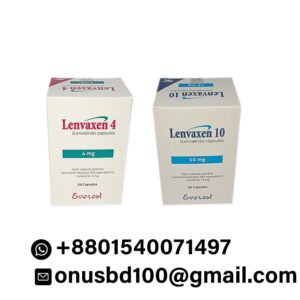
Lenvanix 4 mg is approved for locally recurrent or metastatic, progressive, radioactive iodine-refractory differentiated thyroid cancer (DTC); first-line unresectable hepatocellular carcinoma (HCC); advanced renal cell carcinoma (RCC) with everolimus; advanced endometrial carcinoma with pembrolizumab; and advanced RCC (first-line) with pembrolizumab.
1
2
3
4
MD
Medical Oncologist Review
Board-certified oncologist · 12+ years in thoracic malignancies
Content reviewed against FDA prescribing information, NCCN Guidelines v2.2024, and published Phase III trial data. Last updated June 2026.
These steps help you have an informed conversation. A confirmed EGFR mutation result is the starting point for any treatment decision.
Medical disclaimer: This page is for informational purposes only and does not constitute medical advice, diagnosis, or treatment. It is a prescription medication that must only be used under the supervision of a qualified oncologist. Clinical outcomes data is drawn from published Phase III trials; individual results vary. Always consult your healthcare provider and refer to the full prescribing information before making any treatment decisions. Emergency: call your local emergency services or poison control immediately if you experience serious adverse effects.
Here are key questions to bring to your oncologist — given that hypertension is both the most common and most serious adverse event with this medication, getting blood pressure controlled before the first dose and establishing a clear monitoring plan is the single most important pre-treatment preparation.
Before confirming lenvatinib as your treatment
About hypertension — the most important pre-treatment and ongoing conversation
About cardiac monitoring
About arterial thromboembolism risk
About liver monitoring
About kidney monitoring and proteinuria
About thyroid function — relevant across all indications
About reversible posterior leukoencephalopathy syndrome (RPLS)
About GI risk
About wound healing
About dosing and administration
About drug interactions
About contraception
About monitoring response
About the longer road
A practical tip: Because hypertension occurred in nearly half of patients in the pivotal REFLECT trial and was the most common reason for dose modification, it’s worth asking your oncologist for a specific, written blood pressure threshold that would trigger you calling the office on the same day — rather than waiting until your next scheduled visit — and confirming you have same-day access to your care team specifically for blood pressure concerns during the early weeks of treatment.
This comparison is unusually well-supported by direct evidence — a large, dedicated head-to-head Phase 3 trial compared these two drugs directly in the same first-line setting, making this one of the few truly head-to-head comparisons in our entire series.
Both are oral multikinase inhibitors approved for first-line unresectable HCC
| Sorafenib (Nexavar) | Lenvatinib (Lenvima) | |
|---|---|---|
| FDA HCC approval | 2007 — 11-year monopoly as first-line standard | August 2018 |
| Pivotal HCC trial | SHARP | REFLECT |
| Dosing | 400mg twice daily, empty stomach | 12mg once daily (≥60kg) or 8mg once daily (<60kg), with or without food |
| Key targets | RAF, VEGFR, PDGFR | VEGFR, FGFR1-4, PDGFR, RET, KIT |
The REFLECT trial — the first positive Phase 3 trial against an active comparator in unresectable HCC
REFLECT was the first-ever positive Phase 3 trial against an active comparator in previously untreated patients with unresectable HCC. This framing matters historically: for eleven years after sorafenib’s 2007 approval, every drug tested against it in first-line HCC failed to demonstrate non-inferiority or superiority in overall survival — REFLECT was the first to break this pattern.
The trial enrolled 954 patients randomized to lenvatinib at weight-based dosing or sorafenib 400mg twice daily. Lenvatinib demonstrated a proven treatment effect on overall survival by statistical confirmation of non-inferiority, as well as statistically significant superiority and clinically meaningful improvements in progression-free survival and objective response rate compared to sorafenib.
In plain terms: lenvatinib matched sorafenib on overall survival (non-inferior), while outperforming it on PFS and response rate.
Efficacy — where lenvatinib has the measurable advantage
The OS equivalence combined with lenvatinib’s PFS and ORR superiority is a meaningful clinical finding. A higher response rate matters in HCC because some patients with initially unresectable disease may become candidates for surgery or local ablation if their tumors shrink sufficiently — making ORR clinically relevant beyond just a statistical endpoint.
Side effects — different patterns, not simply “more or less”
The most common adverse events in the lenvatinib group were hypertension (45% vs 31% with sorafenib), fatigue (44% vs 36%), diarrhea (39% vs 46%), decreased appetite (34% vs 27%), arthralgia/myalgia (31% vs 20%), and decreased weight (31% vs 22%). The most common grade 3/4 adverse events included hypertension (24% vs 15%), decreased weight (8% vs 3%), fatigue (7% vs 6%), and proteinuria (6% vs 2%).
The practical pattern: lenvatinib carries more hypertension and proteinuria; sorafenib produces more diarrhea and hand-foot skin reaction. Neither drug is simply “better tolerated overall” — the side-effect profiles are genuinely different, and the choice can reasonably be influenced by which specific toxicities are more manageable for an individual patient.
Dosing convenience — a real practical difference
Lenvatinib’s once-daily dosing with or without food is meaningfully more convenient than sorafenib’s twice-daily, strict empty-stomach requirement. For patients who struggle with medication adherence or have challenging schedules around meals, this is a genuine practical consideration.
Weight-based dosing in HCC — unique to lenvatinib
Lenvatinib’s weight-dependent dose (12mg for ≥60kg, 8mg for <60kg) has no equivalent in sorafenib — which uses a flat 400mg twice-daily dose regardless of body weight. This means HCC patients must have their weight confirmed and dose calculated correctly before starting lenvatinib.
Child-Pugh liver function — both require adequate reserve
Both drugs were studied primarily in Child-Pugh A patients in their pivotal HCC trials. REFLECT additionally excluded patients with ≥50% liver involvement, portal vein invasion of the main portal vein, and certain other features — meaning lenvatinib’s trial population was somewhat more selected than SHARP’s in ways that can affect how broadly the results apply.
Where the current landscape sits — both largely second-tier in modern first-line HCC
As we discussed in the cabozantinib comparison, first-line HCC treatment has moved substantially toward immunotherapy-based combinations (atezolizumab plus bevacizumab, durvalumab plus tremelimumab) at most major centers. Both sorafenib and lenvatinib remain guideline-supported first-line options when immunotherapy combinations are unsuitable — and both have been studied as components of newer combination regimens — but neither represents the current default first choice when all options are available.
Bottom line
REFLECT established lenvatinib as the first drug to match sorafenib’s overall survival in first-line HCC, while outperforming it on PFS and response rate — a genuinely meaningful result that ended sorafenib’s eleven-year status as the only validated first-line option. In clinical practice, lenvatinib is often considered at least equivalent and in some measures superior to sorafenib for first-line HCC in eligible patients, with the practical choice between them driven by individual patient factors: the hypertension and proteinuria burden of lenvatinib versus sorafenib’s diarrhea and hand-foot skin reaction, plus lenvatinib’s more convenient once-daily dosing. Both drugs now sit behind immunotherapy-based combinations in most contemporary treatment guidelines, but remain genuinely relevant options where those combinations aren’t suitable.
Lenvatinib’s FGFR inhibition is the most clinically interesting part of its mechanism — not because VEGFR inhibition is new (sorafenib, cabozantinib, and sunitinib all block VEGFR), but because adding FGFR coverage addresses a specific, well-characterized resistance mechanism that pure anti-VEGFR therapy consistently fails to block.
The shared foundation — VEGFR inhibition as the anti-angiogenic core
Like sorafenib and cabozantinib before it, lenvatinib’s primary anti-tumor mechanism begins with blocking VEGFR (vascular endothelial growth factor receptor) on tumor blood vessel cells, cutting off the new blood supply that cancers depend on to grow beyond a small size. Lenvatinib is a multikinase inhibitor that interrupts the pathways of VEGFR1, VEGFR2, and VEGFR3. This VEGFR blockade prevents the cancer from recruiting new blood vessels — the anti-angiogenic effect shared across this entire drug class.
What makes lenvatinib structurally distinct — FGFR1 through FGFR4
Lenvatinib inhibits other kinases implicated in pathogenic angiogenesis, tumor growth, and cancer progression, including fibroblast growth factor receptors FGFR1, 2, 3, and 4; platelet-derived growth factor receptor alpha (PDGFRα); KIT; and RET.
The FGFR family (fibroblast growth factor receptors 1 through 4) represents the mechanistically important addition. Sorafenib doesn’t meaningfully inhibit FGFR. Cabozantinib inhibits MET and AXL — different resistance pathways — but also lacks significant FGFR coverage. Lenvatinib is the first drug in this conversation that simultaneously blocks both VEGFR and the entire FGFR family.
Why FGFR matters — a second, independent pro-angiogenic pathway
Fibroblast growth factors (FGFs) and their receptors run a parallel pro-angiogenic signaling system alongside the VEGF/VEGFR axis. When tumors are treated with drugs that block VEGFR, they can adapt by upregulating FGF/FGFR signaling as an alternative route to stimulate new blood vessel formation — essentially routing around the VEGFR blockade through a completely separate but functionally equivalent angiogenic pathway.
This FGFR-mediated escape is one of the most well-documented resistance mechanisms in anti-angiogenic therapy, observed across multiple solid tumor types including HCC. A drug that blocks only VEGFR leaves this entire escape route available; lenvatinib’s simultaneous VEGFR and FGFR inhibition cuts off both pathways at once, making it considerably harder for tumor vasculature to find an alternative route to sustain its blood supply.
Why FGFR inhibition is particularly relevant in HCC
Lenvatinib exhibited antiproliferative activity in hepatocellular carcinoma cell lines dependent on activated FGFR signaling, with concurrent inhibition of FGF-receptor substrate 2 (FRS2α) phosphorylation. This is a mechanistically important, HCC-specific finding: some HCC tumors have particularly active FGFR signaling as a driver of their growth — not just as a resistance escape route, but as a primary growth-promoting pathway. For these tumors, lenvatinib’s FGFR inhibition isn’t only blocking a backup pathway; it’s also directly attacking an active proliferative signal driving the cancer.
This direct anti-tumor activity through FGFR inhibition in HCC cell lines — independent of the anti-angiogenic effect — contributes to lenvatinib’s higher objective response rates compared to sorafenib in REFLECT, since response rate reflects tumor shrinkage (direct anti-proliferative effect) more directly than overall survival.
How FRS2α phosphorylation connects mechanism to response
FRS2α (FGF-receptor substrate 2 alpha) is an adaptor protein that, when phosphorylated by activated FGFR, relays the growth signal downstream into the cancer cell. Lenvatinib’s inhibition of FRS2α phosphorylation essentially disconnects FGFR activation from its downstream consequences — even if FGFR kinase activity isn’t completely abolished, blocking this downstream relay prevents the growth signal from actually reaching the cellular machinery it would otherwise switch on.
How this connects to the REFLECT superiority on PFS and ORR
The mechanistic picture directly explains the clinical trial pattern: lenvatinib matched sorafenib on overall survival (because OS in HCC is a complex endpoint influenced by many factors beyond tumor control alone) while outperforming it on PFS and objective response rate — the endpoints most directly reflecting immediate tumor control and shrinkage. A drug that simultaneously blocks VEGFR-driven angiogenesis, FGFR-driven angiogenesis, and FGFR-driven direct tumor proliferation is mechanistically expected to produce more complete and more rapid tumor responses than one blocking only VEGFR and RAF — which is exactly what the trial data showed.
RET inhibition — the thyroid cancer connection
As we discussed with cabozantinib, RET mutations are the primary driver of medullary thyroid cancer specifically. For differentiated thyroid cancer (DTC), the situation is somewhat different — lenvatinib’s RET inhibition contributes to activity against DTC subsets driven by RET rearrangements, but the dominant mechanism in the SELECT trial’s dramatic PFS result (18.3 vs 3.6 months) was more broadly related to the combined VEGFR/FGFR anti-angiogenic blockade in a tumor type that is heavily angiogenesis-dependent.
Why the hypertension is directly mechanism-linked
This connects lenvatinib’s mechanism to its most prominent adverse event. VEGFR2 inhibition is known to reduce nitric oxide production in blood vessel walls — nitric oxide is a key vasodilatory signal, and its reduction causes blood vessels to constrict, raising blood pressure. This is a class effect shared across anti-VEGFR drugs including sorafenib, but lenvatinib’s particularly potent VEGFR inhibition combined with its additional FGFR-driven vascular effects produce a more pronounced hypertension signal than sorafenib — mechanistically explaining why hypertension occurred in 45% of REFLECT patients versus 31% with sorafenib, and why blood pressure control before starting is such a foundational clinical requirement rather than a generic safety caution.
The bigger picture
Lenvatinib’s mechanism represents a deliberate expansion of the anti-angiogenic multikinase inhibitor strategy beyond VEGFR alone — adding FGFR1-4 coverage to simultaneously block the primary and most common backup pathway in tumor angiogenesis, while also providing direct anti-proliferative activity against HCC cell lines driven by FGFR signaling specifically. This dual anti-angiogenic mechanism is the most likely explanation for its superior PFS and ORR versus sorafenib in REFLECT — not simply that it’s a more potent VEGFR blocker, but that it closes off the second, parallel angiogenic escape route that sorafenib’s VEGFR-only approach consistently leaves available.
Conatact US