Address
Road no. 4, Vatara, Notun Bazar
Dhaka, Bangladesh
Address
Road no. 4, Vatara, Notun Bazar
Dhaka, Bangladesh
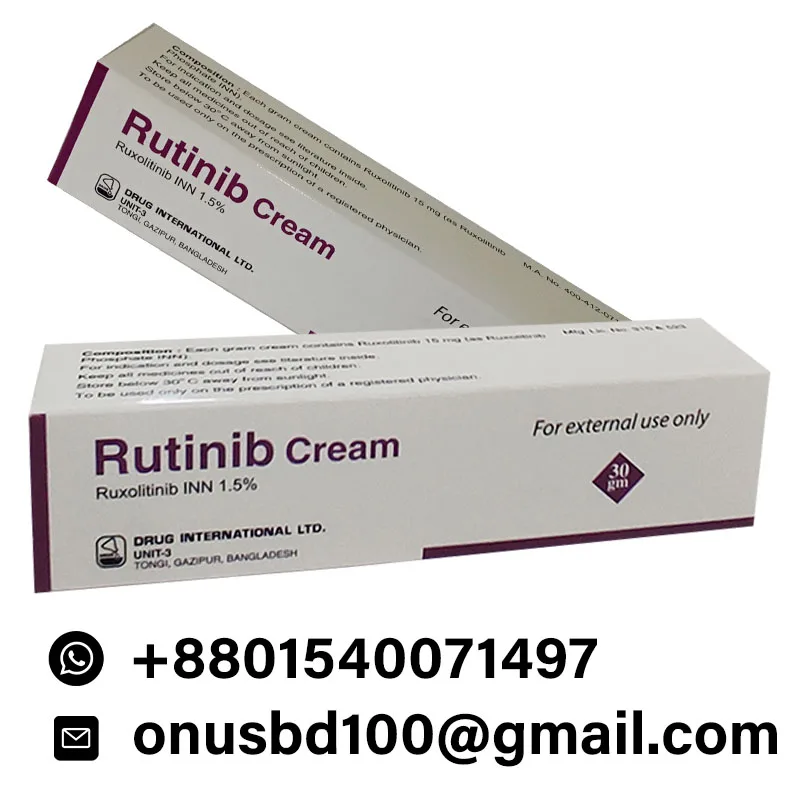
Product Name: Rutinib Cream
Generic: Ruxolitinib 1.5% INN
Quantity: 30gm
Opzelura Alternative
Rutinib (Ruxolitinib) 30 gm cream is a selective, topical Janus kinase (JAK) 1 and 2 inhibitor containing Ruxolitinib 1.5%. It is clinically indicated for the management of nonsegmental vitiligo (to restore skin pigment) and the short-term treatment of mild-to-moderate atopic dermatitis (AD) in non-immunocompromised patients aged 12 and older.
It is available as a 1.5% w/w topical cream in a 30g tube. The standard therapeutic protocol involves applying a thin film twice daily to active lesions. For safety, application should be limited to 20% of the body surface area for eczema and 10% for vitiligo, not exceeding 60g per week.
My Onus Pharma sources Rutinib from Drug International Ltd., utilizing a formulation that has undergone In Vitro Permeation Testing (IVPT) to ensure identical dermal delivery to the innovator. We provide full transparency with batch-specific Certificates of Analysis (COA) and validated shipping protocols to maintain chemical stability.
Yes. Rutinib is a prescription-only medication. Because it modulates the local immune response, it requires professional medical supervision to ensure it is not used on active skin infections and to monitor the patient’s therapeutic progress.
The pathogenesis of vitiligo involves an overactive immune response where CD8+ T-cells attack melanocytes. This attack is mediated by Interferon-gamma (IFN-$\gamma$), which signals through the JAK-STAT pathway.
When applied topically, Rutinib (Ruxolitinib) enters the skin cells and binds to the ATP-binding site of the JAK1 and JAK2 enzymes. By inhibiting these enzymes, the cream effectively blocks the signal that tells the immune system to destroy pigment cells. This creates a “protected zone” in the dermis, allowing dormant melanocytes in the hair follicles to migrate back to the skin’s surface and begin producing melanin again.
In these pivotal Phase III trials involving 674 patients, the primary endpoint was the F-VASI75 (75% improvement in facial pigment).
At 24 Weeks: Approx. 30% of patients achieved F-VASI75 compared to only 7-11% in the control group.
At 52 Weeks: The efficacy significantly increased, with 50% of patients achieving F-VASI75 and over 75% seeing noticeable improvement in body vitiligo. This data proves that Rutinib is a cumulative therapy; the longer the melanocytes are protected from immune attack, the more pigment they can restore.
In the TRuE-AD1 and TRuE-AD2 trials, Rutinib demonstrated a rapid “anti-itch” effect. Patients reported significant reduction in pruritus (itching) within 12 hours of the first application. By week 8, over 50% of patients achieved an IGA score of 0 or 1 (clear or almost clear skin).
Clinical data for topical Ruxolitinib 1.5% shows that Grade 3 and 4 adverse events are rare (<1%). Unlike oral JAK inhibitors, topical application results in very low systemic absorption. The most common treatment-emergent adverse events (TEAEs) are application site acne (approx. 6%) and nasopharyngitis (approx. 3%), which are typically Grade 1 or 2 in severity.
Ruxolitinib is a substrate of the CYP3A4 enzyme. While systemic levels are low with topical use, co-administration with strong CYP3A4 inhibitors (e.g., ketoconazole or clarithromycin) may increase Ruxolitinib exposure. Furthermore, it should not be used in combination with other JAK inhibitors or therapeutic biologics (like Dupilumab) used in oncology or dermatology, as combined immunosuppressive effects have not been clinically studied.
Many patients are concerned about “Boxed Warnings” associated with oral JAK inhibitors (like those used for rheumatoid arthritis). However, Rutinib Cream utilizes a “Systemic Sparing” effect. Clinical Maximum Use Trials (MUsT) show that even when Rutinib 1.5% is applied to a large area of the body, the steady-state plasma concentration remains below 100 nM. This is significantly lower than the 281 nM threshold required to cause systemic side effects like myelosuppression (bone marrow suppression).
Topical Bioavailability: Approximately 6%.
Systemic Concentration: 30–40 times lower than the oral dose. This ensures the drug stays in the skin to fight the disease without entering the bloodstream in high enough quantities to affect the heart or internal organs.
Pediatrics (12+): Clinical trials (TRuE-AD3) have shown that the safety profile in adolescents is identical to adults. Because children have a higher skin-to-body-mass ratio, we strictly enforce the 20% BSA limit to prevent increased absorption.
Geriatrics (65+): No dosage adjustments are typically required for elderly patients. However, we advise monitoring for localized skin thinning if the patient has a history of long-term corticosteroid use, as Rutinib can then be more easily absorbed.
Every batch of Rutinib Cream undergoes a three-tier validation process at the Drug International Ltd. quality control lab:
Chemical Assay: Confirms the Ruxolitinib concentration is exactly 15mg per 1g of cream.
Impurities Profile: Ensures that no degradation products (like Ruxolitinib N-oxide) exceed the strict 0.1% limit.
Physical Stability: The cream is tested for “Phase Separation” under centrifugal stress to ensure the medication remains evenly distributed in the tube for its entire shelf-life.
Rutinib Cream is an emulsion, meaning it can be damaged by extreme freezing or excessive heat. My Onus Pharma utilizes temperature-shielded air-freight packaging. We monitor the “Cold Chain” during transit to ensure the product remains between 15 ° C and 30° C. If a shipment is exposed to temperatures outside this range during transit, our protocol requires a secondary stability check before final delivery to the patient.
While Opzelura is the global brand leader, Rutinib provides a clinically identical alternative for the international market.
Active Ingredient: 100% Bio-identical Ruxolitinib Phosphate.
Excipient Profile: Rutinib uses a slightly higher ratio of humectants (moisturizers), which helps prevent the “dryness” sometimes reported with the innovator brand.
Cost-Effectiveness: Rutinib allows patients to maintain their 12-month treatment cycles (required for vitiligo) at roughly 10% of the cost of the innovator, making long-term repigmentation financially viable.
Rutinib is manufactured by Drug International Ltd. in Bangladesh. Their state-of-the-art facility adheres to World Health Organization (WHO) Good Manufacturing Practices (GMP), featuring automated lines that minimize human contact and ensure high-precision dosing for topical emulsions.

Reviews
There are no reviews yet.