Address
Sector 14, Road no. 18, Uttara, 1230
Dhaka, Bangladesh

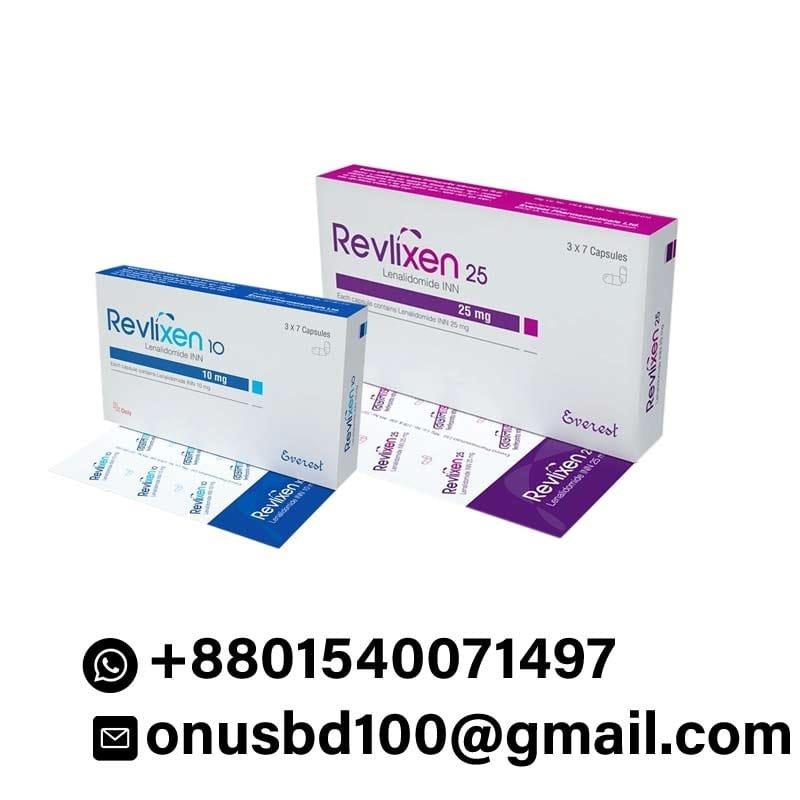
Rx Prescripttion Only-YMYL Medical Content
Approved for adults with multiple myeloma (MM) — in combination with dexamethasone, and as maintenance therapy after autologous stem cell transplant — and for myelodysplastic syndromes (MDS) with deletion 5q (del(5q)) cytogenetic abnormality, and for certain mantle cell lymphoma (MCL) and follicular lymphoma patients (in combination with rituximab).
1
2
3
4
MD
Medical Oncologist Review
Board-certified oncologist · 12+ years in thoracic malignancies
Content reviewed against FDA prescribing information, NCCN Guidelines v2.2024, and published Phase III trial data. Last updated June 2026.
These steps help you have an informed conversation. A confirmed EGFR mutation result is the starting point for any treatment decision.
Medical disclaimer: This page is for informational purposes only and does not constitute medical advice, diagnosis, or treatment. It is a prescription medication that must only be used under the supervision of a qualified oncologist. Clinical outcomes data is drawn from published Phase III trials; individual results vary. Always consult your healthcare provider and refer to the full prescribing information before making any treatment decisions. Emergency: call your local emergency services or poison control immediately if you experience serious adverse effects.
Here are key questions to bring to your hematologist — given lenalidomide’s three-part boxed warning and REMS requirement, the pregnancy/contraception plan and blood clot prevention strategy deserve as much attention as the practical dosing questions.
Before confirming Revlixen (lenalidomide) as your treatment
About the REMS program — required before the first dose
About pregnancy risk and contraception — non-negotiable for anyone of childbearing potential
About blood clot risk — the thromboembolism warning
About blood count monitoring
About kidney function and dosing
About the cycle schedule
About managing common side effects
About second primary malignancies — a longer-term consideration
About my specific situation
About the longer road
A practical tip: Because the REMS enrollment and the pregnancy/contraception requirements must be completed before the first prescription can even be filled, it’s worth asking specifically what the realistic timeline looks like from your first appointment to your first dose — so you’re not caught off guard by administrative steps that, while essential for safety, can take longer than the clinical decision itself.
Lenalidomide and pomalidomide are both immunomodulatory drugs (IMiDs) in the same chemical family as thalidomide, and unlike most of our comparisons, these two are typically used sequentially rather than as alternatives at the same decision point — pomalidomide was specifically developed to work in patients who have already become resistant to lenalidomide.
What they are and how they relate
| Lenalidomide (Revlixen ) | Pomalidomide (Pomalyst) | |
|---|---|---|
| Drug class | Immunomodulatory drug (IMiD), thalidomide analogue | Immunomodulatory drug (IMiD), thalidomide analogue |
| Generation | 2nd-generation IMiD | 3rd-generation IMiD |
| Potency | Reference | More potent in vitro than lenalidomide and thalidomide |
| Approved | 2005 (MDS); 2006 (MM) | 2013 |
| Typical position | Earlier lines — induction, maintenance after transplant | Later lines — after lenalidomide and a proteasome inhibitor have failed |
| Manufacturer | Bristol Myers Squibb (Celgene) | Bristol Myers Squibb (Celgene) |
Pomalidomide retains activity against myeloma cells that have become resistant to lenalidomide — this is its central clinical purpose. It works through the same general immunomodulatory mechanism (binding cereblon, a protein involved in targeted protein degradation) but with structural differences that allow it to overcome at least some lenalidomide-resistance mechanisms.
Where each fits in the treatment sequence
Lenalidomide is typically used:
Pomalidomide is typically used:
This sequential relationship means that for most patients, the relevant question isn’t “which one should I start with” but rather “I’m already on lenalidomide and it’s stopped working — should pomalidomide be next.”
Efficacy in the relapsed/refractory setting
The MM-003 trial, which led to pomalidomide’s approval, compared pomalidomide plus low-dose dexamethasone against high-dose dexamethasone alone in patients who had already failed both lenalidomide and bortezomib. Pomalidomide plus dexamethasone showed significantly improved progression-free survival and overall survival compared to high-dose dexamethasone alone — establishing its value specifically in this heavily pretreated, lenalidomide-refractory population.
This is an important distinction from a head-to-head comparison: pomalidomide wasn’t tested against lenalidomide directly in newly diagnosed patients, because that’s not the clinical question it was designed to answer. It was tested in patients for whom lenalidomide was already known not to be working.
Side effect comparison — broadly similar class, some differences in degree
| Lenalidomide | Pomalidomide | |
|---|---|---|
| Neutropenia | Common | More pronounced — often more significant cytopenias |
| Thrombocytopenia | Common | Present, generally less prominent than neutropenia |
| Venous thromboembolism | Significantly increased risk with dexamethasone | Similarly increased risk — same boxed warning |
| Embryo-fetal toxicity | Boxed warning — REMS required | Same boxed warning — POMALYST REMS required |
| Fatigue | Common | Common |
| Peripheral neuropathy | Less prominent than other myeloma drugs | Less prominent |
| Second primary malignancies | Recognized risk with long-term use | Recognized risk, similar class concern |
Both drugs share the same three-part boxed warning structure (embryo-fetal toxicity, hematologic toxicity, venous thromboembolism) and both require their own REMS program — Pomalidomide’s REMS program is essentially structured the same way as lenalidomide’s, given the shared mechanism and shared teratogenic risk.
The most clinically notable difference is that neutropenia tends to be more pronounced with pomalidomide, often requiring more proactive use of growth factor support (filgrastim or similar) and closer blood count monitoring, particularly in heavily pretreated patients whose bone marrow reserve is already compromised from prior therapies.
Dosing differences
| Lenalidomide | Pomalidomide | |
|---|---|---|
| Typical dose | 25mg once daily, days 1-21 of 28-day cycle (combination); 10mg for maintenance | 4mg once daily, days 1-21 of 28-day cycle |
| Kidney function adjustment | Required — significant renal excretion | Less dependent on kidney function — different elimination pathway, making it an option for some patients with renal impairment where lenalidomide dosing is complicated |
This kidney function difference is practically meaningful: multiple myeloma frequently causes kidney damage (from light chain deposition or other mechanisms), and patients with significant renal impairment may have an easier time with pomalidomide dosing than with lenalidomide, which requires more careful dose reduction based on creatinine clearance.
Cross-resistance — what “lenalidomide-refractory” actually means for pomalidomide
An important nuance: while pomalidomide retains activity in many lenalidomide-refractory patients, response rates in this setting (typically 30-35% overall response in heavily pretreated populations) are generally lower than the response rates lenalidomide itself achieved when used earlier in treatment. This reflects the general pattern in myeloma treatment where each subsequent line of therapy tends to produce somewhat lower response rates than the line before, as the disease accumulates more resistance mechanisms over time.
Combination strategies
Both drugs are increasingly used as part of triplet or quadruplet regimens rather than alone:
Bottom line
Lenalidomide and pomalidomide are best understood as sequential tools in the myeloma treatment journey rather than competing first-choice options — lenalidomide is the earlier-line, more established standard (especially for maintenance after transplant), while pomalidomide exists specifically to provide continued IMiD-class benefit once lenalidomide resistance develops. The shared boxed warnings and REMS requirements mean the safety conversation is largely similar between them, while the practical differences — pomalidomide’s somewhat more pronounced neutropenia and its more favorable profile in renal impairment — become relevant considerations once a patient reaches the point of needing this next-line option. Your specific treatment history, current kidney function, and how your myeloma responded to lenalidomide will shape this conversation with your hematologist.
The REVLIMID REMS program exists because of a specific historical tragedy that fundamentally changed how thalidomide-related drugs are regulated — understanding that history explains why this isn’t ordinary prescribing caution, but a structurally different distribution system.
What REMS means
REMS stands for Risk Evaluation and Mitigation Strategy — a regulatory tool the FDA can require for drugs whose risks are serious enough that normal prescribing safeguards (a doctor’s judgment plus a standard pharmacy dispensing process) aren’t considered sufficient on their own. REMS programs vary in intensity; lenalidomide’s is one of the more restrictive versions, sometimes called “REMS with Elements to Assure Safe Use” (ETASU).
Why lenalidomide specifically needs this — the thalidomide history
Lenalidomide is structurally derived from thalidomide. In the late 1950s and early 1960s, thalidomide was prescribed — often for morning sickness — to pregnant women in dozens of countries before its teratogenic effects were understood. The result was thousands of infants born with severe limb deformities (phocomelia, where limbs are absent or severely shortened), along with other congenital abnormalities affecting the ears, eyes, heart, and internal organs. This remains one of the most significant drug safety failures in medical history and directly shaped modern pharmaceutical regulation, including the requirement for rigorous testing of teratogenic potential before approval.
When lenalidomide was developed decades later as a more potent and differently-tolerated derivative of thalidomide, animal studies confirmed it carries the same fundamental risk — a developmental monkey study showed limb abnormalities similar to those caused by thalidomide in humans. Given this direct mechanistic link to one of history’s most consequential teratogens, regulators required a distribution system specifically designed to make a repeat of that history structurally very difficult, rather than relying solely on physician and patient awareness.
What the REMS program actually requires
The program has several interlocking layers:
Prescriber certification — physicians must register with the program, complete specific training, and agree to follow defined protocols before they can prescribe lenalidomide at all.
Pharmacy certification — only pharmacies registered with the program can dispense it; lenalidomide cannot be filled at just any pharmacy the way most prescriptions can.
Patient registration — patients must enroll in the program, which includes counseling about the risks and required precautions.
Pregnancy testing protocol — for anyone of reproductive potential, two negative pregnancy tests are required before the first dose, followed by regular pregnancy testing throughout treatment (weekly during the first month, then less frequently if cycles are regular, or more frequently if periods are irregular).
Mandatory contraception — two reliable forms of contraception are required simultaneously throughout treatment and for a defined period after stopping, with very limited exceptions (such as confirmed surgical sterilization or abstinence, which must be verified rather than assumed).
Male patient requirements — because lenalidomide is present in semen, male patients — including those who have had a vasectomy — must agree to use condoms during any sexual contact with a person who could become pregnant.
Prescription timing limits — prescriptions are typically limited to no more than a 28-day supply, requiring renewed authorization rather than allowing long-term refills, which keeps the safety checkpoints active throughout treatment rather than only at the start.
Ongoing survey requirements — patients and prescribers periodically complete surveys confirming continued adherence to the safety requirements.
Why this differs from a typical “boxed warning” drug
Many drugs we’ve discussed in this conversation carry boxed warnings and require careful monitoring — but lenalidomide’s REMS program is structurally different. A boxed warning informs and cautions; it relies on the prescriber and patient to act on that information correctly. A REMS program with these elements actually restricts who can prescribe, who can dispense, and how much can be obtained at once, building safety checkpoints directly into the distribution chain rather than relying solely on individual judgment.
Why this matters practically for you as a patient
Understanding this distinction helps explain some practical realities of being on lenalidomide:
The broader principle
The REVLIMID REMS program reflects a hard-won lesson from one of medicine’s most serious historical failures: when a drug’s potential for harm is severe, irreversible, and specifically tied to a documented historical precedent, regulatory systems sometimes go beyond informing prescribers and patients to actively restricting how the drug moves through the healthcare system. This is precisely why the requirements can feel more demanding than for other serious medications — they were built in direct response to what happens when that level of caution isn’t present.


Conatact US