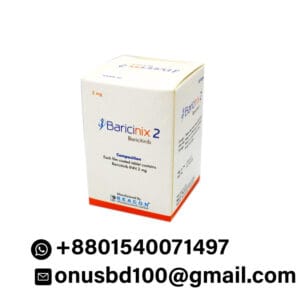
Address
Sector 14, Road no. 18, Uttara, 1230
Dhaka, Bangladesh


Rx Prescripttion Only-YMYL Medical Content
Approved for adults with moderate to severely active rheumatoid arthritis who have had an inadequate response to one or more TNF antagonist therapies, for severe alopecia areata, and for hospitalized adults with COVID-19 requiring supplemental oxygen or mechanical ventilation. This page focuses primarily on its rheumatoid arthritis use.
1
2
3
4
MD
Medical Oncologist Review
Board-certified oncologist · 12+ years in thoracic malignancies
Content reviewed against FDA prescribing information, NCCN Guidelines v2.2024, and published Phase III trial data. Last updated June 2026.
These steps help you have an informed conversation. A confirmed EGFR mutation result is the starting point for any treatment decision.
Medical disclaimer: This page is for informational purposes only and does not constitute medical advice, diagnosis, or treatment. It is a prescription medication that must only be used under the supervision of a qualified oncologist. Clinical outcomes data is drawn from published Phase III trials; individual results vary. Always consult your healthcare provider and refer to the full prescribing information before making any treatment decisions. Emergency: call your local emergency services or poison control immediately if you experience serious adverse effects.
Here are key questions to bring to your rheumatologist — given that baricitinib carries class-wide JAK inhibitor risks around infection, blood clots, and cardiovascular events, getting a clear picture of your personal risk factors and the screening process is the most important groundwork before starting.
Before confirming baricitinib as your treatment
About infection screening — a required first step
About cardiovascular and blood clot risk
About baseline and ongoing blood monitoring
About kidney function
About cholesterol monitoring
About gastrointestinal risk
About dosing
About drug interactions
About what to expect and how we’ll measure success
About the longer road
A practical tip: Because the infection and cardiovascular screening requirements are foundational to starting this medication safely, it’s worth asking your rheumatologist to walk through the complete pre-treatment checklist with you explicitly — TB testing, hepatitis screening, baseline labs, vaccination status — so you have a clear sense of what needs to happen before your first dose, rather than discovering these requirements one at a time.
This is a genuinely important comparison because tofacitinib’s safety data directly shaped how the entire JAK inhibitor class — including baricitinib — is now labeled and prescribed, even though baricitinib itself was never tested in the same large dedicated safety trial.
Different selectivity within the same drug class
| Baricitinib (Olumiant) | Tofacitinib (Xeljanz) | |
|---|---|---|
| JAK targets | More selective for JAK1, strongly preventing STAT phosphorylation by IL-6 | Non-selective first-generation JAK inhibitor — inhibits JAK1, JAK2, JAK3, and to a lesser extent TYK2 |
| Dosing | Once daily | Twice daily |
| FDA approval | 2018 | 2012 |
| Additional approved indications | RA, alopecia areata, COVID-19 | RA plus a broader range including ulcerative colitis |
The JAK3 inhibition is a meaningful structural distinction: tofacitinib acts on JAK3, which baricitinib cannot inhibit — meaning these drugs aren’t simply identical molecules with different brand names, but genuinely different selectivity profiles within the same overall mechanism.
Efficacy — real-world data shows no significant difference
A real-world study comparing 161 tofacitinib patients and 81 baricitinib patients found no significant difference in clinical response between the two groups over 24 weeks, with comparable DAS28-ESR improvement (1.57 vs 1.46) after adjusting for confounders. The most common adverse event in both groups was herpes zoster infection, occurring at similar rates between the two drugs.
A broader, separate indirect comparison across multiple JAK inhibitors found baricitinib and upadacitinib showed therapeutic equivalence based on efficacy data, with tofacitinib showing some inconsistency requiring more data — generally reinforcing that these drugs perform similarly well, without one clearly outperforming the others.
The defining safety event — ORAL Surveillance and its ripple effect across the entire class
This is the most important piece of context for understanding how both drugs are viewed and prescribed today: a large FDA-mandated safety trial (ORAL Surveillance) specifically studying tofacitinib found an increased risk of major adverse cardiovascular events and malignancies compared to TNF inhibitors in RA patients 50 years or older with at least one cardiovascular risk factor — non-inferiority was not demonstrated for either outcome in the final analysis.
This dose-related finding specifically involved the 10mg twice-daily dose of tofacitinib, which isn’t even approved for RA — it’s only approved for ulcerative colitis — an important nuance, since the RA-approved tofacitinib dose is lower (5mg twice daily) than the dose that showed the clearest pulmonary embolism and mortality signal.
Critically, this trial’s findings extended beyond tofacitinib itself: on September 1, 2021, the FDA issued a drug safety communication requiring revisions to the Boxed Warning for tofacitinib, baricitinib, AND upadacitinib, including risk of serious heart-related events, cancer, blood clots, and death — even though neither baricitinib nor upadacitinib had been studied in a similarly large, dedicated safety trial themselves. The FDA extrapolated tofacitinib’s findings across the entire drug class as a precautionary measure, given the shared mechanism.
An important, sometimes overlooked detail — baricitinib had its own earlier warning signal
Even prior to ORAL Surveillance, concerning safety signals appeared during baricitinib’s own clinical trials regarding increased venous thromboembolism risk — suggesting this may be a genuine class effect of JAK inhibitors rather than a risk unique to tofacitinib’s particular JAK1/JAK3 selectivity profile. There was a definite increased VTE risk specifically observed with the baricitinib 4mg dose.
This is worth being direct about: baricitinib isn’t simply “the safer alternative” to tofacitinib just because it wasn’t subject to the same large dedicated safety trial — it had its own earlier, independent VTE safety signal during development, which is part of why regulators applied the boxed warning class-wide rather than assuming the risk was tofacitinib-specific.
Real-world adverse event reporting shows somewhat different patterns
An analysis of FDA adverse event reports found baricitinib-related reports had the highest proportions of death (7.2%) and cancer-related events (4.1%) among the three JAK inhibitors studied, while tofacitinib-related reports had the highest proportions of cardiovascular-related (14.1%) and blood clot-related (14.8%) events. This kind of post-marketing reporting data has real limitations (it can’t establish causation the way a randomized trial can, and reporting patterns can be influenced by many factors), but it’s a useful real-world data point suggesting the two drugs may carry somewhat different proportional risk patterns even while sharing the same overall boxed warning.
Regulatory response — the EMA took a more nuanced, population-specific approach
The EMA’s review of this same data did not change the overall line-of-therapy positioning for JAK inhibitors, but did limit their use in certain higher-risk subpopulations specifically — patients 65 years and older, those with a history of atherosclerotic cardiovascular disease or other cardiovascular risk factors, current or long-time former smokers, and those at increased cancer risk — recommending JAK inhibitors only be used in these groups when no suitable treatment alternative exists. This represents a more risk-stratified regulatory response than the FDA’s blanket boxed warning, and is worth being aware of if you fall into one of these specific higher-risk categories.
Bottom line
Baricitinib and tofacitinib show comparable real-world efficacy for rheumatoid arthritis, with no significant difference found in direct comparative studies. The defining safety story for both drugs is the FDA-mandated ORAL Surveillance trial, which found increased cardiovascular and malignancy risk with tofacitinib specifically — but this finding triggered a class-wide boxed warning extended to baricitinib as well, partly because baricitinib had shown its own earlier, independent venous thromboembolism signal during its own development. Neither drug should be viewed as the clearly “safer” choice based on current evidence; both carry the same FDA boxed warning for serious cardiovascular events, blood clots, cancer, and death, particularly relevant for patients 50 and older with cardiovascular risk factors. This is exactly the kind of decision where your personal cardiovascular risk profile, age, smoking history, and prior treatment response should be discussed directly and specifically with your rheumatologist, since the choice between these two drugs is now understood to carry meaningfully overlapping risk considerations rather than one being a clearly lower-risk alternative to the other.
JAK inhibition is a great example of disrupting a cellular communication relay system rather than blocking a single signal at its source — baricitinib doesn’t target any one inflammatory molecule directly, but instead interrupts the shared internal machinery that many different inflammatory signals depend on to actually get their message delivered inside the cell.
The basic biology — how cytokines communicate with cells
Rheumatoid arthritis is driven by chronic, excessive inflammation in the joints, fueled by a range of signaling molecules called cytokines — including interleukin-6 (IL-6), interferon-gamma, and others — that circulate in the body and tell immune cells to ramp up inflammatory activity. These cytokines work by binding to specific receptors on the surface of cells, but here’s the key step that’s easy to overlook: binding to the surface receptor alone doesn’t directly change anything inside the cell. The signal needs to be relayed from the cell surface into the nucleus, where it can actually influence which genes get switched on.
JAK enzymes — the relay station inside the cell
Janus kinases (JAKs) are enzymes that transduce intracellular signals from cell surface receptors for a number of cytokines and growth factors involved in haematopoiesis, inflammation, and immune function. In plain terms, JAK enzymes sit just inside the cell membrane, physically attached to the inner tail of cytokine receptors. When a cytokine binds to its receptor from outside the cell, this triggers the attached JAK enzymes to activate.
STAT proteins — carrying the message to the nucleus
Within the intracellular signaling pathway, JAKs phosphorylate and activate signal transducers and activators of transcription (STATs), which activate gene expression within the cell. Once activated, JAK enzymes chemically tag (phosphorylate) STAT proteins, which then change shape, pair up, and travel into the cell’s nucleus — where they directly bind to DNA and switch on the genes responsible for producing more inflammatory proteins, perpetuating and amplifying the inflammatory response.
This JAK-STAT pathway is essentially the cell’s internal messaging system specifically built to convert an external cytokine signal into an actual change in gene activity and cellular behavior.
How baricitinib interrupts this relay
Baricitinib modulates these signaling pathways by partially inhibiting JAK1 and JAK2 enzymatic activity, thereby reducing the phosphorylation and activation of STATs. By blocking JAK1 and JAK2 specifically, baricitinib prevents the chemical tagging step that would normally activate STAT proteins — without this activation, STATs can’t travel to the nucleus and switch on the genes that drive ongoing inflammation. The inflammatory signal essentially gets stuck at the cell surface, unable to complete its journey to actually change what the cell does.
Why blocking JAK1/JAK2 specifically targets such a broad range of inflammatory signals
This is the elegant part of the strategy, and it connects directly to baricitinib’s particular selectivity profile we discussed in the tofacitinib comparison: baricitinib acts more selectively on JAK1 than tofacitinib, strongly preventing STAT phosphorylation specifically triggered by interleukin-6 (IL-6) — a cytokine that’s particularly central to rheumatoid arthritis’s inflammatory cascade. Because JAK1 and JAK2 are shared relay components used by multiple different cytokine receptors — not just one single inflammatory pathway — blocking these enzymes simultaneously dampens signaling from several different inflammatory cytokines at once, rather than requiring a separate drug for each individual cytokine.
This is fundamentally different from how a biologic drug like a TNF inhibitor works — TNF inhibitors physically neutralize one specific cytokine (TNF-alpha) before it can even reach its receptor, working entirely outside the cell. JAK inhibitors, by contrast, work inside the cell, after multiple different cytokines have already bound their respective receptors, blocking the shared downstream relay system that several of these different signals rely on to actually produce their inflammatory effect.
Why this explains baricitinib’s effectiveness after TNF inhibitor failure
This mechanistic distinction directly explains why baricitinib is specifically indicated for patients who’ve had an inadequate response to TNF antagonist therapy: if a patient’s inflammation is being driven substantially by cytokines other than TNF-alpha — such as IL-6 — a drug that only blocks TNF-alpha specifically won’t address those other contributing pathways. By working further downstream, inside the cell, and affecting multiple cytokine pathways that all funnel through JAK1/JAK2, baricitinib can interrupt inflammatory signaling that a TNF-specific biologic simply isn’t positioned to touch.
Why partial, rather than complete, inhibition matters
It’s worth noting baricitinib partially inhibits JAK1 and JAK2 enzymatic activity rather than completely shutting it down. This partial inhibition reflects a deliberate balance: JAK1 and JAK2 aren’t only involved in disease-driving inflammation — they also play essential roles in normal immune function and blood cell production (hematopoiesis). Completely blocking these enzymes would likely cause severe immune suppression and blood count problems; partial inhibition aims to meaningfully dampen the excessive, disease-driving signaling in rheumatoid arthritis while preserving enough normal JAK1/JAK2 function to avoid catastrophic immune or blood-forming consequences.
Why this same mechanism explains several side effects we’ve discussed
This connects directly to the safety profile covered on the product page and in the tofacitinib comparison. Because JAK1 and JAK2 are also essential for normal immune surveillance and blood cell production:
Increased infection risk — partially suppressing JAK-STAT signaling dampens part of the immune system’s normal ability to detect and respond to pathogens, including latent infections like tuberculosis, which is exactly why pre-treatment TB screening is required.
Blood count effects — JAK2 in particular plays an important role in the bone marrow’s production of red blood cells, white blood cells, and platelets, which is why treatment should be avoided or interrupted in patients with hemoglobin less than 8 g/dL, absolute lymphocyte count less than 500 cells/mm³, or absolute neutrophil count less than 1000 cells/mm³.
Cardiovascular and clotting effects — while the precise mechanism behind the class-wide cardiovascular and thrombotic risk we discussed isn’t fully established, it’s thought to relate at least partly to JAK-STAT signaling’s broader role in vascular and immune cell function beyond just the inflammatory pathways being targeted therapeutically.
The bigger picture
Baricitinib’s mechanism represents a fundamentally different strategic approach to treating rheumatoid arthritis compared to older biologic therapies: rather than neutralizing one specific inflammatory cytokine from outside the cell, it works inside the cell to partially block a shared relay system that multiple different inflammatory cytokines depend on to actually change cellular behavior. This broader, multi-cytokine-pathway approach is precisely why it can be effective in patients whose disease hasn’t adequately responded to a single-target biologic like a TNF inhibitor — but this same broad mechanism, touching pathways essential to normal immune function and blood cell production, is also exactly why the safety monitoring requirements we’ve discussed throughout this conversation are built so directly into how this medication is used in practice.
Conatact US