Address
Sector 14, Road no. 18, Uttara, 1230
Dhaka, Bangladesh

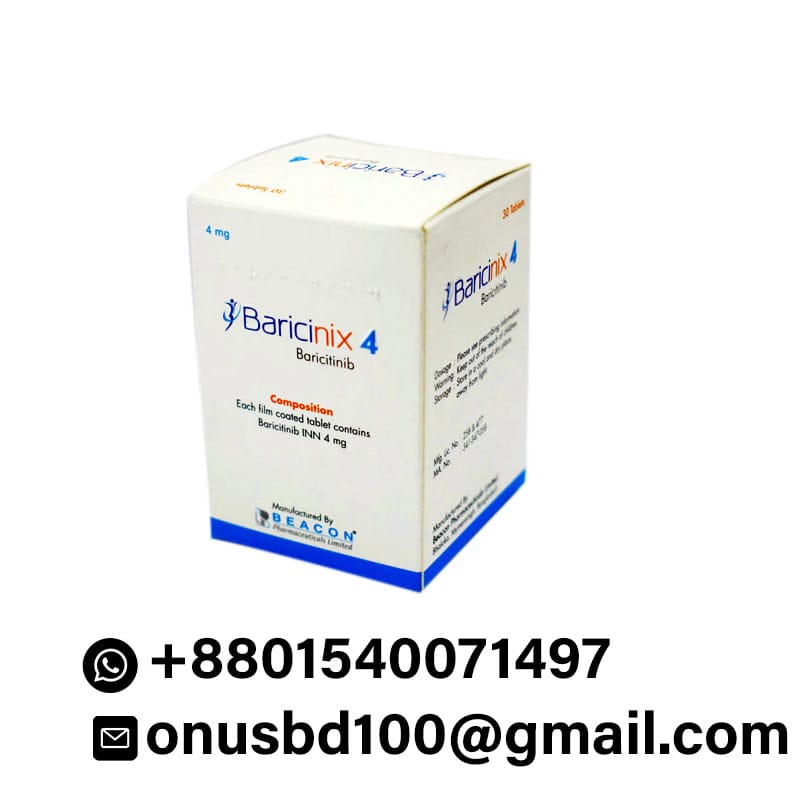
Rx Prescripttion Only-YMYL Medical Content
Approved for adults with moderate to severely active rheumatoid arthritis who have had an inadequate response to one or more TNF antagonist therapies, for severe alopecia areata, and for hospitalized adults with COVID-19 requiring supplemental oxygen or mechanical ventilation. This page focuses on the standard 4mg rheumatoid arthritis dose.
1
2
3
4
MD
Medical Oncologist Review
Board-certified oncologist · 12+ years in thoracic malignancies
Content reviewed against FDA prescribing information, NCCN Guidelines v2.2024, and published Phase III trial data. Last updated June 2026.
These steps help you have an informed conversation. A confirmed EGFR mutation result is the starting point for any treatment decision.
Medical disclaimer: This page is for informational purposes only and does not constitute medical advice, diagnosis, or treatment. It is a prescription medication that must only be used under the supervision of a qualified oncologist. Clinical outcomes data is drawn from published Phase III trials; individual results vary. Always consult your healthcare provider and refer to the full prescribing information before making any treatment decisions. Emergency: call your local emergency services or poison control immediately if you experience serious adverse effects.
Here are key questions to bring to your rheumatologist — since 4mg is the standard starting dose for most adults, the first useful step is confirming there’s no specific reason you should actually be on the lower 2mg dose instead, followed by the same infection and blood work screening that applies before starting any JAK inhibitor.
Before confirming the 4mg dose is right for you
About infection screening — a required first step
About cardiovascular and blood clot risk
About baseline and ongoing monitoring
About cholesterol monitoring
About gastrointestinal risk
About dosing
About drug interactions
About what to expect and how we’ll measure success
About the longer road
A practical tip: Since 4mg is the default starting dose but not automatically the right one for everyone, it’s worth asking your rheumatologist to walk through, out loud, why 4mg specifically fits your situation rather than the lower dose — confirming that age, kidney function, and infection history have all genuinely been considered, rather than assuming the standard dose applies by default.
The short answer is: clinically, these should be the same medicine — same active ingredient, same mechanism, same expected effect on your rheumatoid arthritis. The differences are about manufacturing origin, regulatory pathway, and practical factors like cost and availability, not about a different drug working differently in your body.
Same active ingredient, different commercial origins
| Olumiant® | Barigen | Baricinix | |
|---|---|---|---|
| Manufacturer | Eli Lilly (originator) | General Pharmaceuticals Ltd. (Bangladesh) | Beacon Pharmaceuticals Ltd. (Bangladesh) |
| Status | Brand-name, original | Generic | Generic |
| Active ingredient | Baricitinib | Baricitinib | Baricitinib |
All three tablets are meant to deliver the identical molecule — baricitinib — to your body, working through the same JAK1/JAK2 inhibition mechanism we discussed earlier. None of these is a different drug or a modified version; they’re the same chemical compound manufactured by different companies.
What “brand-name” vs. “generic” actually means
Olumiant is the originator product — Eli Lilly developed baricitinib, ran the original clinical trials (including the RA-BEACON and RA-BUILD trials we’ve cited throughout this conversation), and brought it to market first. This is the product that underwent the full, original FDA and EMA approval process based on those pivotal trials.
Barigen and Baricinix are generic versions — manufactured after baricitinib’s patent protections allowed other companies to produce and sell the same active ingredient, typically at a substantially lower cost. Because of patent exemptions for Bangladeshi companies, manufacturers like these can produce patented drugs to support access for patients globally — this is a recognized, legal regulatory pathway that exists specifically to improve medication affordability and access in many countries.
What regulatory approval generic versions actually go through
A generic drug isn’t simply “copied” without oversight — it generally needs to demonstrate bioequivalence to the original, meaning it delivers the same active ingredient to the bloodstream in essentially the same concentration and timeframe as the brand-name product. This is the regulatory principle that allows a generic to be considered therapeutically equivalent rather than just chemically similar.
That said, it’s worth being transparent: the level of regulatory rigor, manufacturing oversight, and quality assurance can vary between regulatory jurisdictions and individual manufacturers in ways that aren’t always fully visible to a patient simply reading a product label. This is a genuine, honest limitation of generic markets globally, not unique to baricitinib specifically.
Why three different generic brands of the same drug exist at all
This reflects normal pharmaceutical market dynamics rather than anything concerning: once a drug’s patent protections allow generic competition, multiple manufacturers often enter the same market, each producing and marketing their own branded version of the identical generic compound. This is similar to how you might see multiple brands of generic ibuprofen or acetaminophen on a pharmacy shelf — different company names, same underlying medicine.
What practically differs between these specific products
What should NOT differ
The dose strength (2mg or 4mg), the active ingredient, the mechanism of action, the expected efficacy for rheumatoid arthritis, and the safety profile — including the FDA boxed warning we’ve discussed regarding cardiovascular events, blood clots, cancer, and serious infections — should all be the same across Olumiant, Barigen, and Baricinix, since they’re all delivering identical baricitinib.
A practical recommendation if you’re switching between brands
If your pharmacy or supplier changes which brand you’re given between refills, this is generally not something to be alarmed about, but it is reasonable to mention to your rheumatologist, particularly if you notice any change in how you’re responding to treatment or in side effects after a brand switch. While this shouldn’t happen if true bioequivalence has been properly established, individual patient experiences occasionally vary for reasons that aren’t always fully understood, and your rheumatologist would want to know if that occurs so they can investigate appropriately.
The bigger picture
The distinction between Olumiant, Barigen, and Baricinix is fundamentally a commercial and regulatory one — who manufactured the tablet and through what approval pathway — rather than a clinical one about how the medicine works in your body. All three are intended to deliver the same therapeutic baricitinib molecule, at the same dose strengths, for the same approved uses. If you have specific concerns about quality assurance for a particular manufacturer or product you’ve been prescribed, that’s a reasonable and worthwhile question to raise directly with your prescribing rheumatologist or pharmacist, who may have more specific knowledge about regulatory standing and quality track record for products available in your particular region.
We covered this in detail earlier in our conversation — let me pull that explanation forward rather than repeat the research, since the mechanism hasn’t changed.
The basic biology — how cytokines communicate with cells
Rheumatoid arthritis is driven by chronic, excessive inflammation in the joints, fueled by signaling molecules called cytokines — including interleukin-6 (IL-6), interferon-gamma, and others — that tell immune cells to ramp up inflammatory activity. These cytokines bind to receptors on the cell surface, but that binding alone doesn’t change anything inside the cell. The signal needs to be relayed from the surface into the nucleus, where it can switch on the genes responsible for inflammation.
JAK enzymes — the relay station inside the cell
Janus kinases (JAKs) are enzymes that transduce intracellular signals from cell surface receptors for a number of cytokines and growth factors involved in haematopoiesis, inflammation, and immune function. JAK enzymes sit just inside the cell membrane, attached to cytokine receptors. When a cytokine binds from outside, the attached JAK enzymes activate.
STAT proteins — carrying the message to the nucleus
Within the intracellular signaling pathway, JAKs phosphorylate and activate signal transducers and activators of transcription (STATs), which activate gene expression within the cell. Activated STAT proteins travel into the nucleus and switch on genes that produce more inflammatory proteins, perpetuating the inflammatory cycle.
How baricitinib interrupts this relay
Baricitinib modulates these signaling pathways by partially inhibiting JAK1 and JAK2 enzymatic activity, thereby reducing the phosphorylation and activation of STATs. Blocking this step prevents STAT proteins from being activated and reaching the nucleus, so the inflammatory signal gets stuck before it can change gene activity.
Why blocking JAK1/JAK2 hits multiple inflammatory pathways at once
Baricitinib acts selectively on JAK1, strongly preventing STAT phosphorylation triggered by IL-6 — a cytokine particularly central to rheumatoid arthritis. Because JAK1 and JAK2 are shared relay components used by several different cytokine receptors, blocking them dampens signaling from multiple inflammatory pathways simultaneously, rather than requiring a separate drug for each cytokine. This is fundamentally different from a TNF inhibitor, which neutralizes one specific cytokine outside the cell.
Why this works after TNF inhibitors fail
If a patient’s inflammation is driven substantially by cytokines other than TNF-alpha — like IL-6 — a TNF-specific biologic won’t address those pathways. Baricitinib works further downstream, inside the cell, affecting multiple cytokine pathways that funnel through JAK1/JAK2, which is exactly why it’s indicated for patients who’ve had an inadequate response to TNF antagonist therapy.
Why inhibition is partial, not complete
Baricitinib partially inhibits JAK1 and JAK2 rather than shutting them down entirely, since these enzymes also support normal immune function and blood cell production. Partial inhibition aims to dampen disease-driving inflammation while preserving enough normal function to avoid severe immune suppression or blood count problems.
Why this explains the side effects we’ve discussed
Because JAK1/JAK2 support normal immune surveillance and bone marrow function:
The bigger picture
Baricitinib works inside the cell to partially block a shared relay system that multiple inflammatory cytokines depend on, rather than neutralizing one cytokine from outside the cell the way a TNF inhibitor does. This broader, multi-pathway approach explains both why it can help patients who haven’t responded adequately to TNF inhibitors, and why the safety monitoring requirements — infection screening, blood counts, kidney function — are built so directly into how this medication is used, since the same mechanism that controls disease-driving inflammation also touches pathways essential to normal immune and blood-cell function.


Conatact US