Address
Sector 14, Road no. 18, Uttara, 1230
Dhaka, Bangladesh

Rx Prescripttion Only-YMYL Medical Content
Approved for first-line treatment of metastatic non-small cell lung cancer (NSCLC) in adults whose tumors have EGFR exon 19 deletion or exon 21 L858R substitution mutations, as detected by an FDA-approved companion diagnostic test.
1
2
3
4
MD
Medical Oncologist Review
Board-certified oncologist · 12+ years in thoracic malignancies
Content reviewed against FDA prescribing information, NCCN Guidelines v2.2024, and published Phase III trial data. Last updated June 2026.
These steps help you have an informed conversation. A confirmed EGFR mutation result is the starting point for any treatment decision.
Medical disclaimer: This page is for informational purposes only and does not constitute medical advice, diagnosis, or treatment. It is a prescription medication that must only be used under the supervision of a qualified oncologist. Clinical outcomes data is drawn from published Phase III trials; individual results vary. Always consult your healthcare provider and refer to the full prescribing information before making any treatment decisions. Emergency: call your local emergency services or poison control immediately if you experience serious adverse effects.
Here are key questions to bring to your oncologist — given that dacomitinib sits in a competitive first-line EGFR landscape alongside osimertinib, the “why this drug for me specifically” conversation is as important as the practical management questions.
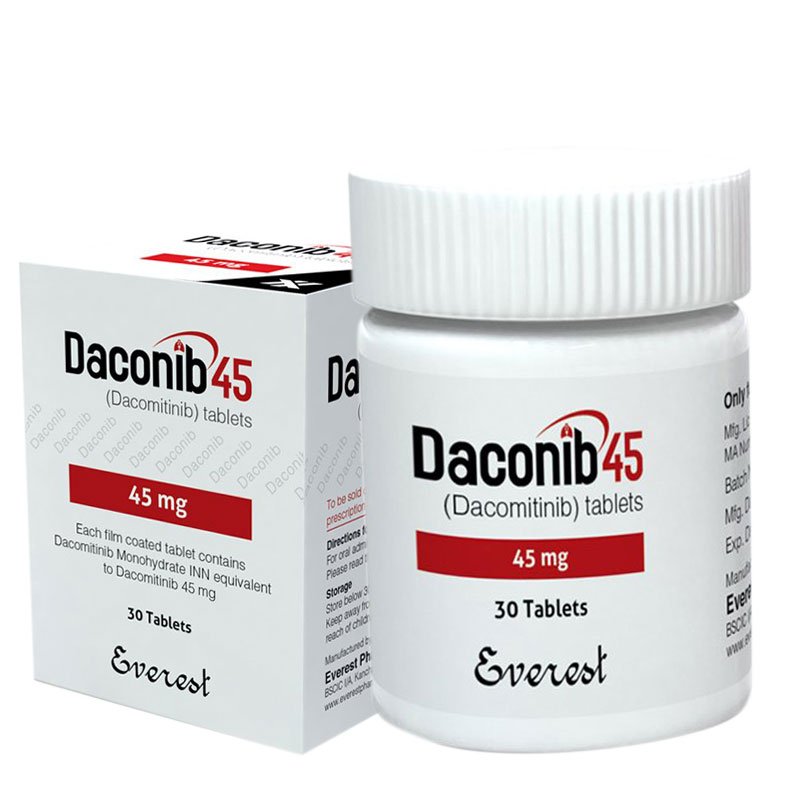
Before confirming Daconib(dacomitinib) as your treatment
About the PPI and acid-suppression interaction — often overlooked
About dosing
About managing the most common side effects
About ILD/pneumonitis — the most serious risk
About monitoring overall
About the longer-term EGFR sequencing picture
About my specific situation
About access and support
A practical tip: Because the PPI interaction is so common and so easy to overlook, it’s worth bringing a complete list of every medication you take — including supplements and over-the-counter products — to this appointment. Many patients take PPIs without thinking of them as medications that matter for cancer treatment, and this is one where the interaction genuinely affects how well the drug works.
This is one of the most actively debated treatment decisions in thoracic oncology right now — two drugs targeting the same mutations, both with phase III survival data, but with meaningfully different profiles. Unlike most of our earlier comparisons, this one genuinely involves two options competing for the same patient at the same treatment moment.
What they are and how they differ mechanistically
| Dacomitinib | Osimertinib | |
|---|---|---|
| Generation | 2nd — pan-EGFR/HER2/HER4 inhibitor | 3rd — EGFR/T790M selective inhibitor |
| Binding | Irreversible (covalent) pan-HER inhibitor | Irreversible, mutant-selective |
| T790M coverage | No — if T790M resistance develops, dacomitinib stops working | Yes — designed to overcome T790M |
| CNS penetration | Limited | Significantly better — established CNS activity |
| FDA approved first-line | 2018 | 2018 (accelerated); 2020 (regular) |
Both drugs bind EGFR irreversibly, but osimertinib’s third-generation design gives it selectivity for the mutant form of EGFR over wild-type EGFR — a feature that contributes to its generally more favorable side-effect profile compared to pan-EGFR inhibition.
Head-to-head efficacy — the critical point
These two drugs have never been directly compared against each other in a randomized trial. Their efficacy data comes from separate phase III trials against different comparators:
| Dacomitinib vs gefitinib (ARCHER 1050) | Osimertinib vs erlotinib/gefitinib (FLAURA) | |
|---|---|---|
| Median PFS | 14.7 mo vs 9.2 mo | 18.9 mo vs 10.2 mo |
| Median OS | 34.1 mo vs 26.8 mo | 38.6 mo vs 31.8 mo |
| 24-month PFS rate | 30.6% vs 9.6% | ~44% vs ~27% |
The numbers favor osimertinib numerically, but these are cross-trial comparisons with different patient populations, different comparator arms, and different time periods — which is why oncologists are careful not to declare one definitively superior based on these figures alone. That said, most current guidelines (NCCN, ESMO) now list osimertinib as the preferred first-line agent, with dacomitinib as an alternative.
CNS disease — a meaningful clinical differentiator
This is arguably the most important clinical distinction for many patients. Lung cancer frequently spreads to the brain — and osimertinib’s CNS penetration is substantially better established than dacomitinib’s:
For patients with existing brain metastases, or who have disease features that increase CNS spread risk, this difference often resolves the choice in favor of osimertinib.
Side effect comparison — dacomitinib’s higher burden
| Dacomitinib | Osimertinib | |
|---|---|---|
| Diarrhea | ~87% (any grade) | ~46% |
| Rash/acneiform | ~69% | ~41% |
| Paronychia | ~64% | ~25% |
| Stomatitis | ~45% | ~29% |
| ILD/pneumonitis | Present (~2%) | Present (~3.5%) |
| QTc prolongation | Less prominent | Requires monitoring |
| Dose reduction required | Very common — majority of patients need ≥1 reduction | Less common |
| Discontinuation due to AEs | Higher | Lower |
The side-effect burden difference is clinically significant. In ARCHER 1050, a large proportion of patients required dose reduction from 45mg to 30mg or 15mg — this is so common it’s essentially built into the treatment plan rather than being an exception. Osimertinib’s once-daily dosing with lower rates of skin, GI, and nail toxicity translates to better quality-of-life measures in most analyses.
The sequencing argument — where it gets strategically complex
The most nuanced part of this comparison concerns what happens after each drug stops working:
After dacomitinib fails — T790M resistance develops in roughly 40-50% of patients, at which point osimertinib becomes the next treatment option (since it was specifically designed for T790M). This “sequential” strategy was the basis for an argument that using dacomitinib first preserves osimertinib for second-line use.
After osimertinib fails — the resistance mechanisms are more heterogeneous (C797S, MET amplification, HER2 amplification, small-cell transformation, and others), and none of them are cleanly addressable with dacomitinib or other available EGFR TKIs. This means the post-osimertinib landscape is more complex and less well-defined than the post-dacomitinib landscape.
The counter-argument — and the one that has won in most current guidelines — is that using osimertinib first provides the longest progression-free interval, better CNS protection throughout treatment, and a more tolerable quality of life during what is often the longest period of disease control a patient will experience. The downstream second-line options can be dealt with at the time they’re needed, and delaying that best period of control in hopes of preserving a second-line option is not clearly beneficial.
The PPI restriction — a practical first-line consideration
One underappreciated practical factor: dacomitinib’s absorption is significantly reduced by proton pump inhibitors and H2 blockers, which are extremely common medications. Osimertinib does not have this restriction. For patients who rely on acid suppression therapy for reflux or gastric protection, this creates either a compliance challenge or a need to switch acid-suppression strategies — an added layer of management that doesn’t exist with osimertinib.
Where dacomitinib might be specifically considered
Despite osimertinib’s guideline preference, there are scenarios where dacomitinib remains a reasonable clinical choice:
Bottom line
Osimertinib has emerged as the guideline-preferred first-line choice for EGFR-mutated NSCLC based on numerically superior survival data, better CNS penetration, a more favorable side-effect profile, and a simpler drug interaction profile. Dacomitinib remains an active, approved, and clinically meaningful option — particularly where access, cost, or specific clinical circumstances make it the more practical choice — and its irreversible pan-EGFR inhibition provides real disease control that improved substantially on first-generation drugs. The conversation with your oncologist about which fits your specific situation, disease characteristics, and what you value most in treatment is the essential next step.
This is a genuinely interesting pharmacology question — and the answer is more elegant than a simple drug-drug interaction. It comes down to basic chemistry of how dacomitinib dissolves, and how PPIs change the environment it needs to dissolve in.
The core issue — dacomitinib needs an acidic stomach to dissolve
Dacomitinib is a weakly basic molecule. Like many oral targeted cancer drugs, it has poor water solubility at neutral pH but dissolves well in an acidic environment. The normal human stomach maintains a pH of roughly 1.5–3.5 — strongly acidic — which is exactly the environment dacomitinib needs to dissolve effectively before being absorbed in the small intestine.
When dacomitinib tablets arrive in the stomach, the acid environment breaks the drug into its ionized, soluble form. This soluble form then passes into the small intestine where absorption through the gut wall into the bloodstream occurs.
What PPIs do — and why it matters here
Proton pump inhibitors (omeprazole, esomeprazole, pantoprazole, lansoprazole, rabeprazole) work by irreversibly blocking the proton pumps (H+/K+ ATPase enzymes) in the stomach lining that produce acid. This is precisely their therapeutic purpose — raising stomach pH to reduce acid-related symptoms like reflux and ulcers.
The result is that stomach pH rises from the normal 1.5–3.5 range to around 4–6 or higher during PPI therapy, depending on the dose and timing. At this elevated pH, dacomitinib’s solubility drops dramatically — the drug essentially can’t dissolve properly, passes through the stomach undissolved, and is poorly absorbed from the intestine.
Studies of dacomitinib pharmacokinetics showed that co-administration with acid-reducing agents can reduce dacomitinib exposure (AUC) by approximately 30–40% or more — a clinically meaningful reduction that could translate to subtherapeutic drug levels and reduced efficacy.
Why H2 blockers are handled differently
H2 receptor antagonists (famotidine, ranitidine, cimetidine) also reduce stomach acid, but through a different mechanism — they block histamine receptors that stimulate acid production, rather than the proton pump itself. Their effect on stomach pH is less potent and shorter-lived than PPIs, which is why the prescribing guidance for dacomitinib allows H2 blockers with strict timing separation (taking dacomitinib at least 6 hours before or 10 hours after an H2 blocker) rather than avoiding them entirely.
Simple antacids (like calcium carbonate, magnesium hydroxide) act even more briefly and locally, and can generally be timed around dacomitinib without the same degree of concern — though spacing them out is still advisable.
Why PPIs can’t simply be “timed around”
This is the key practical point: PPIs can’t be scheduled around dacomitinib the way H2 blockers can, because PPIs have a prolonged pharmacodynamic effect that outlasts their plasma concentration. Even after a PPI is absorbed and cleared from the bloodstream, the proton pumps it has already blocked remain inhibited for 18–24 hours or longer — until new proton pump proteins are synthesized. This means there’s no timing window that makes a PPI safe to take on the same day as dacomitinib with confidence that absorption won’t be affected.
The practical consequence
For patients who genuinely need acid suppression — particularly those with significant reflux, Barrett’s esophagus, or a history of peptic ulcer disease — this creates a real management challenge. Options typically discussed include:
This is worth a specific conversation with both your oncologist and your gastroenterologist or primary care doctor — because stopping a PPI that was prescribed for a real indication (like Barrett’s esophagus protection) without a plan isn’t appropriate, and the solution needs to account for both the cancer treatment and the underlying GI condition.
Why this class of interaction is broader than just dacomitinib
Dacomitinib is far from alone in this — many oral targeted cancer therapies have the same pH-dependent absorption issue, including erlotinib, some CDK4/6 inhibitors, and several other kinase inhibitors. It’s one of the reasons that medication review at the start of any new oral targeted therapy should always include a specific check for acid-suppression medications, not just cytotoxics and immunosuppressants.
Conatact US