Address
Road no. 4, Vatara, Notun Bazar
Dhaka, Bangladesh
Address
Road no. 4, Vatara, Notun Bazar
Dhaka, Bangladesh
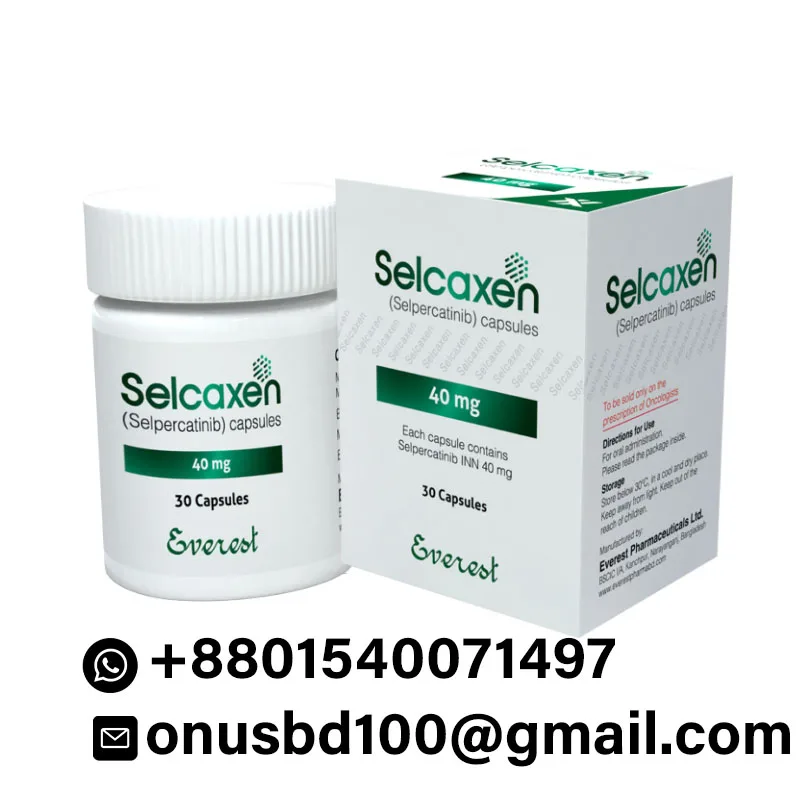
Product Name: Selcaxen
Generic Name: Selpercatinib
Quantity: 30 Capsules
WhatsApp, WeChat, Telegram : +8801540071497
Selcaxen 40 mg is a RET receptor tyrosine kinase inhibitor. It is used to treat metastatic non-small cell lung cancer driven by RET fusion. It is also indicated to treat Medullary Thyroid Cancer. This lung cancer targeted therapy works by inhibiting RET (Re-arranged during transfection) tyrosine kinase that stimulates cancer cells to grow and spread.
Type Selcaxen 40 mg has been approved for certain RET gene-driven cancers. This drug won approval because of how well and how long it worked in initial studies. Approval may be contingent on ongoing or future trials that demonstrate its advantages. Indications: SELCAXEN® is a kinase inhibitor indicated for the treatment of:
All of these approvals have been made based on preliminary promising data in clinical trials, with ongoing research to establish longer-term benefits and results.
Selpercatinib is a highly selective kinase inhibitor designed to target cancers driven by RET gene alterations. It works by blocking the activity of both wild-type RET and several mutated RET isoforms, disrupting signals that promote tumor growth.
In preclinical studies, Selpercatinib proved to inhibit RET since IC50 values were measured at 0.92 nanomolar, underlining its strong activity even at very low concentrations. It also inhibited VEGFR1 and VEGFR3 and, at higher, though still clinically relevant concentrations, affected FGFR1, FGFR2, and FGFR3.
Notably, in cellular assays, Selpercatinib inhibited RET signaling at concentrations:
This high level of selectivity ensures that Selpercatinib targets RET-driven tumors effectively, while minimizing off-target effects on other kinases, contributing to its tolerability and clinical potential.
Dosage and administration for both RET fusion metastatic non-small cell lung cancer and Medullary Thyroid cancer are below.
To treat RET fusion metastatic lung cancer
To treat Medullary Thyroid Cancer
Certain medications may interact with Selcaxen 40 mg in the body, reducing its efficacy or increasing the likelihood of side effects. Learn them for safe and effective treatment.
On the other hand, strong or moderate inducers of CYP3A can lower Selcaxen levels, reducing its ability to fight cancer effectively. These combinations should also be avoided.
Patients taking Selcaxen 40 mg may experience some side effects, as with many cancer treatments. The most commonly reported include:
Not everyone will experience these side effects, and some may be milder or temporary. It’s important to stay in regular contact with your healthcare provider, who can help manage any symptoms that arise during treatment.
Even though Selcaxen 40 mg has demonstrated pronounced clinical efficacy in treating patients with RET-altered cancers, there are several important safety concerns to be considered during its administration. Below are key adverse events that require careful monitoring and management:
Adverse liver effects were reported in a low percentage of patients, 2.6%. To lower the risk, liver enzymes should be checked before treatment initiation and then every two weeks for the first three months, and then monthly or as needed. Depending on the intensity of the reaction, the treatment may need to be paused and the dose adjusted or stopped.
Hypertension occurred in over one-third of the patients, with some being severe Grade 3 or 4. Most cases were manageable with blood pressure medications. The priority is to ensure that the blood pressure is under control. Monitoring should begin one week after starting therapy and at least monthly. The severity may require dose modifications or treatment interruption.
It is a possibility that Selcaxin can cause a certain change to the electrical rhythm of the heart, known as dose-dependent QT prolongation. Up to 6% of the patients were observed with QTcF more significant than 500 ms, with 15% increase by 60 ms or more. It is recommended to use it with caution in patients with known cardiac disease or pre-existing electrolyte imbalance. Before treatment, as well as periodically during treatment, testing for electrolytes, TSH, and ECG is warranted. Use of the drug requires added caution, as well as proper monitoring, in combination with other drugs that are known to prolong QT or inhibit CYP3A.
In rare cases (2.3%), Selcaxen 40 mg has been associated with serious or even fatal bleeding events, including cerebral hemorrhage and bleeding at surgical or tumor sites. Treatment should be permanently discontinued if a patient experiences life-threatening bleeding.
Hypersensitivity was reported in just over 4% of patients, with symptoms such as fever, rash, joint or muscle pain, and lab changes like low platelets or elevated liver enzymes. Most reactions appeared within the first few weeks of treatment. If this occurs, Selcaxen 40 mg should be paused,d and corticosteroid therapy started.
The drug can be reinitiated at a lower dose after resolution of symptoms and increased incrementally as steroids are tapered off to the dose that is targeted. If the reaction returns, the drug should be stopped permanently.
The TLS is an infrequent but potentially severe complication, and its incidence was reported in approximately 1% of patients who have had MTc. It usually occurs in patients with rapidly proliferating tumors, extensive tumor involvement, or pre-existing kidney disease. Close monitoring of these subjects and prophylactic hydration and other supportive measures should therefore be implemented before and during treatment.
The safety and efficacy of Selcaxen 40 mg in patients with MTC up to 12 years of age and adolescents are for systemic therapy and for advanced RET fusion-positive thyroid cancer, which does not take radioactive iodine up to a dose of radioactive iodine (where appropriate), and derive from trials in adults, with additional data on pharmacokinetics and safety in the adolescent population.
No studies have been done in children below the age of 12 years for this lung cancer targeted therapy. Its safety and efficacy in this age group are not known. Also, the use of this medication in children for any other indication has not been proven.
Regular check-ups are needed for teenagers with open growth plates since the medication can influence bone growth. If there are any issues are found, then based on the doctor’s analysis, considering the risks and benefits, the treatment would either be stopped or discontinued.
Of the patients that received Selcaxen tablet, 702 to be exact, 34% were above 65 and 10% above 75. There appeared to be no major differences in the response or the side effect profiles within older and younger patients; therefore, it does not seem that age, by itself, will influence the outcome of the treatment.
Dosage adjustment is not warranted in mild to severe renal impairment (eGFR 15–89 mL/min/1.73 m2 by MDRD). Since Selcaxen 40 mg has not been studied in ESRD patients, its use in such patients should be with caution.
Dose modification is recommended for patients with severe hepatic impairment as evidenced by total bilirubin >3 × ULN with any elevation of AST. Dose adjustment is not necessary for mild or moderate hepatic function impairment, but patients should be monitored for liver-related adverse reactions during treatment.
Findings from animal studies indicate that taking Selcaxen 40 mg during pregnancy may harm the fetus. The suggestion is not to take this drug while pregnant or to use proper contraception during this treatment. There is no available data on whether it is harmful or not. But from animal studies, researchers have assumed that it may harm.
Breastfeeding during treatment with this drug is not recommended, because breast milk may contain the chemical substance of selcaxen and harm children.
Male fertility may be compromised while taking the medication. Male patients must take proper preservation of their male fertility before this treatment. In this matter, they can consult their doctor.
Selcaxen 40 mg is produced by Everest Pharmaceuticals Ltd., a well-established, world-renowned pharmaceutical company that is recognized for its commitment to quality, innovation, and affordability. State of the art manufacturing systems and strict quality control processes are in place to ensure that the medicines Everest manufactures are safe, effective, and reliable,e but can be availed at rates that are affordable to the common man.
Through these concerted efforts, Onus Pharma’s Global Access Initiative plays a pivotal role in addressing healthcare disparities and improving patient outcomes on a global scale.
Patients throughout the world now have access to Selcaxen 40 mg via Onus Pharma’s global distribution network. In collaboration with reputable manufacturers and logistical partners, Onus Pharma offers timely and reliable delivery of premium medications to areas where advanced cancer therapy is lacking or not available.
Selcaxen (Selpercatinib) has been evaluated in several clinical trials to establish the safety and effectiveness of targeting RET-altered cancers, including individuals with RET fusion-positive non-small cell lung cancer (NSCLC) and RET-mutant medullary thyroid cancer (MTC).
It has demonstrated a high disease control rate and a durable anticancer activity, even in patients previously exposed to other treatments.
Research on this drug is ongoing to investigate its potential in other types of tumors and in other treatment settings. Investigators are also examining its long-term safety and efficacy, as well as combination therapy and use among pediatric patients. This ongoing scientific pursuit demonstrates an increasing dedication to increasing the number of treatment options available and ultimately improving outcomes for patients with RET-associated cancers.

Reviews
There are no reviews yet.