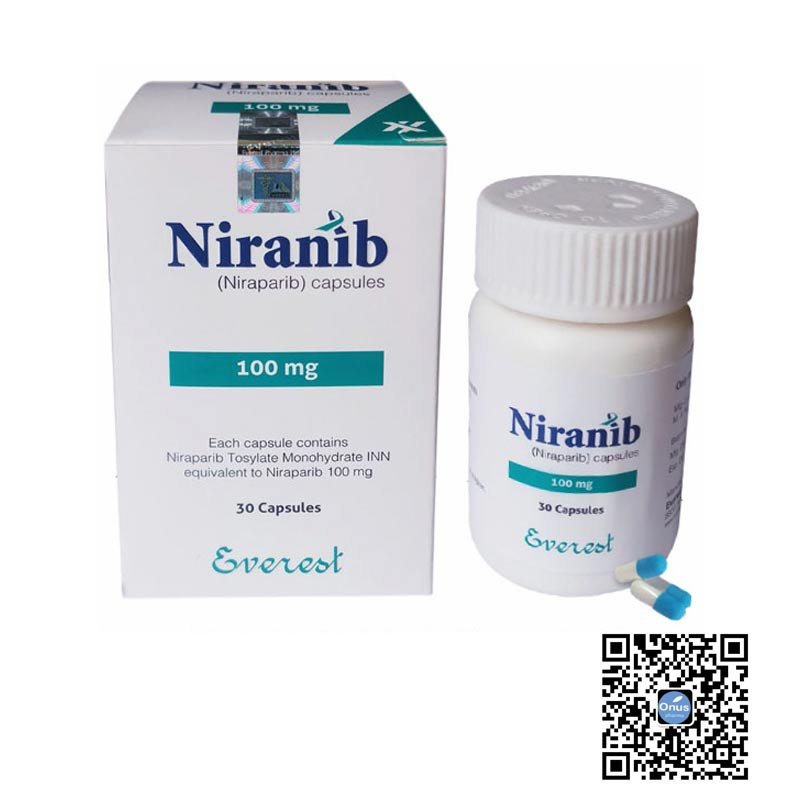
Niranib 100 mg Capsule is an FDA-approved maintenance treatment for adult patients with advanced epithelial ovarian, fallopian tube, or primary peritoneal cancer who are in complete or partial response to first-line platinum-based chemotherapy.
The brand name of this medicine is ZEJULA, and Niranib is a generic version manufactured in Bangladesh and marketed globally by Everest Pharmaceuticals Ltd., Bangladesh.
Indications for using Niranib 100 mg Capsule
- For the maintenance treatment of adult patients who have been diagnosed with advanced epithelial ovarian, fallopian tube, or primary peritoneal cancer who are in complete or partial response to first-line platinum-based chemotherapy.
- For the treatment of adult patients with recurrent epithelial ovarian, fallopian tube, or primary peritoneal cancer who are in complete or partial response to first-line platinum-based chemotherapy.
- For the treatment of fallopian, ovarian, and primary peritoneal cancer patients who have been treated with three or more chemotherapy regimens and whose cancer is associated with homologous recombination deficiency (HRD) positive status, defined by either a harmful or suspected harmful BRCA mutation, or genomic instability, who have progressed more than six months after response to the last platinum-based chemotherapy.
Mechanism of Action
This medication works by blocking PARP enzymes (PARP-1 and PARP-2), which help repair damaged DNA in cancer cells. When these enzymes are inhibited, cancer cells cannot repair themselves and eventually die.
This medicine is especially effective in cancers with BRCA1 or BRCA2 gene mutations or other DNA repair problems, helping slow or stop tumor growth.
Niranib 100 mg Capsule Dosage and Administration
- Start treatment with Niranib 100 mg immediately after 8 weeks of the chemotherapy regimen.
- Take 300 mg to treat recurrent ovarian cancer before noon by mouth and continue until disease progression or unacceptable toxicity.
- To treat advanced epithelial, ovarian, fallopian tube, or peritoneal cancer in adult patients, suggested doses are 2oo mg by mouth before noon for <77 kg (170 lbs) and 300 mg for ≥77 kg. Start treatment immediately after 12 months of platinum-based chemotherapy.
Dosage Modification
Start with 200 mg
- First reduction is 100 mg
- Discontinue if the patient can’t take 100 mg
Start with 300 mg
- First reduction is 200 mg
- Second reduction is 100 mg
- Discontinue if the patient can not take 100 mg
Administration and Proper Uses
- Take the medicine according to your health care provider’s instructions. Do not take more or less of it. If you can not tolerate general doses of the drug, inform your doctor, who may reduce your doses or suggest other medicines to lower the side effects. In case of taking a dose, contact your doctor immediately.
- Take the whole medicine with water. Do not chew or crush the tablet; swallow it whole with a sufficient amount of water.
- You may take the medicine with or without food.
- If you have experienced hormone receptor-positive breast cancer, you should continue hormone medicine and consult your doctor.
- Do not eat grapefruit, Seville orange, or their juice.
What should I know before taking Niranib 100 mg Capsule?
Every medicine has some good sides and some bad sides. After these problems, we have to use medicines to cure diseases. But if we know the pros and cons before using any medicines, it makes our journey easy. I think the following matters should concern you before taking this medication.
Drug interaction
There are some drugs that you can not take together with Niraparib; if you do so, they will interact with each other and cause serious side effects. There are some drug names listed below that have properties to interact with this medication.
- Rubella Virus Vaccine, Live
- Smallpox Monkeypox Vaccine
- Typhoid Vaccine
- Varicella Virus Vaccine
- Yellow Fever Vaccine
- Bacillus of Calmette and Guérin Vaccine, Live
- Dengue Tetravalent Vaccine, Live
- Levoketoconazole
- Measles Virus Vaccine, Live
- Mumps Virus Vaccine, Live
It is not possible to list every drug that interacts with Niranib. Please ask your doctor about other medicines.
Allergies
If you have any record of allergies in the previous or present, please tell your doctor about that. You also should tell your doctor if you have any food allergies, medicine allergies, or any other factor that triggers your allergy. Your doctor will take proper steps for you.
Uses in children
There is no official permission from the brand to use this medication to treat children below 12 years of age. That may cause severe side effects in the children.
If the children are above 12 years old, doctors may use this medicine with dosage modification or in combination with other medicines to reduce the side effects.
Pregnancy and Lactation
- Based on findings from animal studies, research on rats shows that taking Niranib 100 mg capsule during pregnancy has a risk of fetal harm to the fetus.
- Childbearing potential women should take proper contraception during treatment and for at least six months after treatment.
- Based on findings from reproductive studies, male patients should also take proper contraception during treatment and should not donate sperm after 3 months of treatment.
- Do not conceive a baby while taking this medication
- If you are already pregnant and the doctor has prescribed you this medication, consult with the doctor.
- Chemical substances in the medication can remain for months. Do not get pregnant immediately after discontinuing the drug.
- Do not breastfeed during the treatment. It will harm your children.
- Consult your doctor after discontinuing the medication to start breastfeeding.
Other medical problems
Tell your doctor if you have medical problems like
- Liver disease
- Heart attack or heart failure history in the previous.
- Kidney disease
- Eye vision problem
- Lung disease and
- Bone marrow problem
Niranib 100 mg Side Effects
The most adverse side effects of the Niraparib capsule are
- Nausea,
- Thrombocytopenia,
- Fatigue/asthenia,
- Anaemia,
- constipation,
- vomiting,
- abdominal pain,
- neutropenia,
- insomnia,
- headache,
- decreased appetite,
- nasopharyngitis,
- diarrhoea,
- dyspnea,
- hypertension,
- dyspepsia,
- back pain,
- dizziness,
- cough,
- urinary tract infection,
- arthralgia,
- palpitations, and dysgeusia.
Precautions and Warnings
- Keep contacting your doctor to monitor your health to see the progress. It is very important to inform your every movement to the doctor so that they can monitor you.
- If you are pregnant and you are taking this medicine, it can harm your unborn baby. So, consult your doctor before taking this medicine if you are pregnant.
- Do not donate sperm if you are getting treatment by Niranib. Because your sperm will contain chemical waste from the medicine if you are treating prostate cancer.
- This medicine can cause bone marrow problems, including several types of leukemia.
- Tell your doctor right away if you see blood in the urine or in the stool. Also, tell your doctor if the color of your urine and stool changes.
- This medicine increases the risk of blood clots, so be careful while taking the medicine.
How should I store Niraparib?
Store Niranib at room temperature between 68° to 77°F (20 °C to 25°C). Keep this and all medicines out of the reach of children.
Niranib Price in Asia and the Middle East
In Bangladesh, Niranib by Everest Pharma costs around $9 per capsule, while Parivac by Ziska Pharma is priced at $7 USD. Indian prices vary depending on brand and source.
Zejula (GSK) and local generics are available through oncology suppliers, typically at higher prices than Bangladeshi generics. Across Asia, Bangladesh offers the most affordable options, while in the Middle East, Niraparib is mainly supplied through hospitals or authorized distributors at premium international rates.
FAQs about Niranib Capsules
How soon after chemo can I start Niranib 100 mg?
Usually, doctors suggest starting this medication after 8 weeks of completing successful platinum-based chemotherapy when blood counts recover and no disease progression is observed. The oncologist will confirm readiness to start this medication based on lab results, overall recovery, and treatment response.
How long does Niranib stay in your system?
It has a half-life of about 36 hours, meaning it takes roughly 7–8 days to be cleared from the body completely after the last dose. Clearance time may vary depending on kidney and liver function, dosage, and individual metabolism.
How long can you take Niranib 100 mg?
It is recommended by oncologists to take this medicine as long as beneficial to the patients and severe side effects are not seen. Some patients stay on therapy for months to several years, depending on response, tolerance, and disease control under medical supervision.
What is the difference between Niraparib and Olaparib?
Both are PARP inhibitors used in ovarian and breast cancers. Niraparib is taken once daily and can be used with or without BRCA mutations, while Olaparib is taken twice daily and mainly for BRCA-mutated cancers.
Niraparib commonly causes low platelets, whereas Olaparib often leads to anemia and fatigue. Both work by blocking DNA repair in cancer cells.
Disclaimer: Do not use this information as a medical substitute; always consult your doctor before taking any prescription medicine.




Reviews
There are no reviews yet.