Address
Sector 14, Road no. 18, Uttara, 1230
Dhaka, Bangladesh

Rx Prescripttion Only-YMYL Medical Content
Approved for adults with locally advanced or metastatic urothelial carcinoma (bladder cancer) harboring susceptible FGFR3 genetic alterations, as detected by an FDA-approved companion diagnostic, whose disease has progressed on or after at least one prior line of systemic therapy — and who have received prior PD-1/PD-L1 checkpoint inhibitor therapy.
1
2
3
4
MD
Medical Oncologist Review
Board-certified oncologist · 12+ years in thoracic malignancies
Content reviewed against FDA prescribing information, NCCN Guidelines v2.2024, and published Phase III trial data. Last updated June 2026.
These steps help you have an informed conversation. A confirmed EGFR mutation result is the starting point for any treatment decision.
Medical disclaimer: This page is for informational purposes only and does not constitute medical advice, diagnosis, or treatment. It is a prescription medication that must only be used under the supervision of a qualified oncologist. Clinical outcomes data is drawn from published Phase III trials; individual results vary. Always consult your healthcare provider and refer to the full prescribing information before making any treatment decisions. Emergency: call your local emergency services or poison control immediately if you experience serious adverse effects.
Here are key questions to bring to your oncologist — the ophthalmology monitoring requirement and the phosphate management plan are the two areas that are most distinctive to this drug and worth understanding clearly before starting.
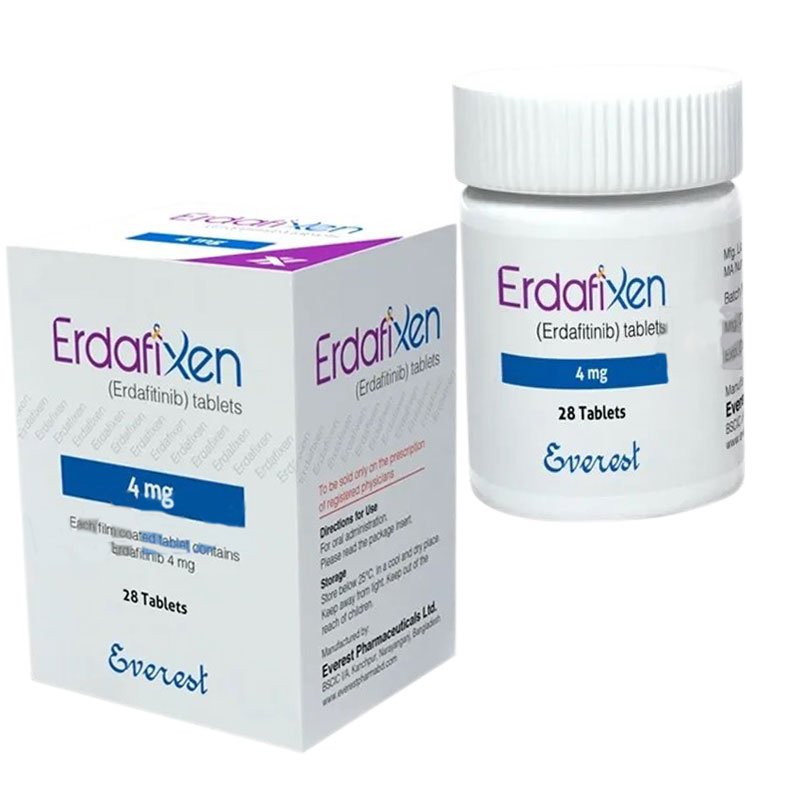
Before confirming Erdafixen(erdafitinib) as your treatment
About the eye monitoring — the most distinctive requirement for this drug
About phosphate levels and up-titration
About the PPI and grapefruit restrictions
About dosing and schedule
About managing other common side effects
About monitoring overall
About my specific situation
About the longer road
A practical tip: Because monthly ophthalmology visits are genuinely part of the treatment protocol — not optional follow-ups — it’s worth identifying an ophthalmologist familiar with drug-related retinal toxicity before starting, and confirming that your oncologist and eye specialist have a clear communication pathway. Finding that specialist after visual symptoms develop is harder and slower than setting up the monitoring relationship in advance.
FGFR3 testing in bladder cancer has an interesting history — unlike EGFR testing in lung cancer (where testing was adopted alongside the first targeted drug), FGFR3 mutations in bladder cancer were identified and studied for years before an approved drug existed to act on them. The testing infrastructure was essentially waiting for the drug, rather than the other way around.
What’s being tested
FGFR3 (Fibroblast Growth Factor Receptor 3) is a receptor tyrosine kinase involved in cell growth and differentiation. In urothelial carcinoma, FGFR3 alterations drive tumor growth through two main mechanisms:
Point mutations — single nucleotide changes at specific positions in the FGFR3 gene that cause the receptor to be constitutively active (permanently “switched on”), even without its normal growth factor signal. The most common include S249C, R248C, G370C, Y373C, and several others — these are the “susceptible FGFR3 mutations” referred to in erdafitinib’s indication.
Gene fusions — rearrangements where part of the FGFR3 gene fuses with another gene (most commonly TACC3), creating an abnormal fusion protein that also drives uncontrolled signaling. These fusions are less common than point mutations but are equally targetable by erdafitinib.
Together, susceptible FGFR3 mutations and fusions are found in roughly 10–20% of locally advanced or metastatic urothelial carcinomas — meaning the majority of bladder cancer patients won’t have this alteration, but for those who do, it defines a targetable subgroup.
Sample source
Both tissue and blood-based testing are used:
Tumor tissue — from a biopsy or prior surgical specimen (including TURBT — transurethral resection of the bladder tumor, which is commonly how bladder cancer is initially diagnosed and staged). Archival tissue from a prior procedure is often sufficient if it’s of adequate quality.
Liquid biopsy (urine or blood) — an interesting feature of bladder cancer specifically is that tumor DNA can shed into urine, making urine-based ctDNA testing a potential non-invasive alternative or complement to tissue testing. Blood-based liquid biopsy is also used. Urine-based FGFR3 testing has been an area of active development given the accessibility and non-invasive nature of urine collection in a disease that originates in the urinary tract.
How the lab analyzes it
Two companion diagnostics are FDA-approved specifically alongside erdafitinib:
therascreen FGFR RGQ RT-PCR Kit — a PCR-based assay designed to detect specific known FGFR3 mutations and fusions from tissue samples. This was the original companion diagnostic validated with erdafitinib’s accelerated approval in 2019.
FoundationOne CDx — a comprehensive genomic profiling panel using NGS that detects FGFR3 alterations alongside hundreds of other cancer-relevant genes simultaneously. This broader panel is particularly useful when comprehensive genomic profiling is being done for treatment planning across multiple potential targets.
The PCR-based assay is faster and more targeted; NGS panels take longer but provide a complete molecular picture of the tumor that may inform other treatment decisions beyond just FGFR3.
Timeline
PCR-based FGFR3 testing typically returns results in 1–2 weeks. NGS comprehensive panels generally take 2–3 weeks. Urine-based testing, where available, can sometimes return faster given easier sample collection logistics.
What the result means for treatment
| Result | What it typically means |
|---|---|
| Susceptible FGFR3 mutation detected (e.g., S249C, R248C, G370C, Y373C) | Erdafitinib is potentially indicated after prior systemic therapy including PD-1/L1 |
| FGFR3 fusion detected (e.g., FGFR3-TACC3) | Same — erdafitinib indication covers susceptible fusions |
| FGFR3 alteration detected but not a “susceptible” variant | May not qualify for erdafitinib — not all FGFR3 alterations are covered by the approval |
| FGFR3 negative | Erdafitinib not indicated; other treatment lines considered |
The “susceptible” qualification — an important nuance
Not every FGFR3 alteration detected on a genomic test qualifies a patient for erdafitinib. The FDA approval specifically covers a defined list of susceptible alterations — those that were included in the clinical trials and shown to respond. If a report shows an FGFR3 variant that isn’t on that list, it’s worth specifically asking your oncologist and the molecular pathology team whether that specific alteration falls within the approved indication, rather than assuming any FGFR3 finding automatically qualifies.
Re-testing considerations
Unlike some cancers where a single upfront test is definitive, bladder cancer is notable for its molecular heterogeneity and evolution over time — FGFR3 mutation status can differ between the primary tumor and metastatic sites, and between an early specimen and a later progression biopsy. If archival tissue was tested years ago and results were negative, re-testing on a more recent biopsy is worth discussing with your oncologist, particularly since testing methods have also improved substantially since earlier years of FGFR3 assay development.
A practical nuance
Because bladder cancer patients often have multiple prior procedures (TURBT, biopsies, cystectomy specimens), there’s usually existing tissue available for testing without requiring a new invasive procedure — which is meaningfully different from some solid tumors where re-biopsy is the only option. Asking your urologist or oncologist which existing specimen is most suitable (most recent, adequate tumor content, properly preserved) can save time compared to arranging a new biopsy when tissue may already be available in the pathology archive.
Hyperphosphatemia from erdafitinib is one of the most mechanistically interesting side effects we’ve encountered in this entire conversation — because unlike most drug side effects (which represent unintended toxicity), the phosphate elevation here is a direct, predictable consequence of the drug doing exactly what it’s designed to do. Understanding why it happens actually helps explain how the drug works.
The mechanism — FGFR signaling normally suppresses phosphate retention
Under normal physiology, the body maintains tight phosphate balance through a hormone called FGF23 (Fibroblast Growth Factor 23), which is produced by bone cells and acts on the kidneys to increase phosphate excretion in urine. FGF23 delivers this signal by binding to and activating FGFR receptors in the kidney — specifically a complex involving FGFR1 and a co-receptor called Klotho.
When erdafitinib inhibits FGFR signaling throughout the body — not just in tumor cells, but in normal kidney tissue too — it blocks this FGF23-FGFR signaling axis in the kidney. The result: the kidney loses the signal telling it to excrete phosphate, phosphate reabsorption increases, and serum phosphate rises.
This is an on-target, class-effect consequence of FGFR inhibition — it happens with all FGFR inhibitors to varying degrees, not just erdafitinib, and it’s mechanistically unavoidable given how the drug works.
Why phosphate levels are actually used to guide dosing
This is what makes erdafitinib unusual: because hyperphosphatemia is a predictable pharmacodynamic marker of FGFR inhibition, serum phosphate level has been used as a surrogate measure of adequate drug exposure. In the THOR trial protocol, patients who did not show sufficient phosphate elevation within the first few weeks (suggesting possible under-exposure) were eligible for dose up-titration from 8mg to 9mg daily.
So paradoxically, some degree of phosphate elevation is actually the intended signal that the drug is reaching its target — it’s managed rather than eliminated entirely.
What hyperphosphatemia means clinically
Chronically elevated phosphate can cause:
Most cases seen with erdafitinib are manageable rather than immediately dangerous, but they require active monitoring and dietary intervention to prevent accumulation over the months of treatment.
How it’s managed — a layered approach
Dietary phosphate restriction is the first line of management. High-phosphate foods that patients are typically asked to reduce or avoid include:
Many erdafitinib prescribing centers provide a specific dietary phosphate restriction guide as part of treatment initiation — asking for this proactively is worth doing.
Phosphate-binding medications are added when dietary restriction alone doesn’t keep phosphate within target range. These work by binding dietary phosphate in the gut before it can be absorbed, reducing the amount entering the bloodstream. Common options include calcium carbonate, sevelamer, and lanthanum carbonate — taken with meals rather than at the same time as erdafitinib, since timing matters for their effectiveness.
Dose modification — if phosphate rises above a defined threshold despite dietary and medication management, erdafitinib dose reduction or temporary interruption is the next step. The prescribing information includes specific phosphate level thresholds that guide these decisions.
Monitoring schedule
Serum phosphate is typically checked:
The connection to ocular toxicity
It’s worth noting that the phosphate-related calcification mechanism is thought to contribute to some of erdafitinib’s ocular side effects — calcium-phosphate deposits can accumulate in the cornea and conjunctiva, contributing to dry eye, eye irritation, and more serious retinal changes. This is one reason why managing phosphate levels well throughout treatment isn’t just about kidney protection — it’s also part of protecting vision over the longer term of treatment.
The practical takeaway
Hyperphosphatemia from erdafitinib is predictable, expected, and manageable — but it requires active engagement rather than passive monitoring. Starting a dietary phosphate restriction plan from day one (rather than waiting until phosphate is already elevated), having a clear threshold for when to add a phosphate binder, and knowing exactly how frequently phosphate will be checked are all worth establishing explicitly with your oncology team before the first dose, rather than developing the management plan reactively once levels rise.
Conatact US